Making the axles is the first step for me making toy cars, and most important if you want the toys to roll smoothly. You can buy pre-made dowels. I would recommend maple, since it's readily available, generally pretty hard, and easy to find in straight grain.
In general, you'll want a diffuse-porous wood. In North America, this means one of the following woods: alder; aspen; beech; birch; hophornbeam; ironwood; live oak; madrone; mountain mahogany; maple; myrtle; or sycamore. Fruit woods, such as Apple, Cherry, or Plum will work too.
You'll also want grain as straight as you can get. Twisty grain will make life hard for you, and the axles will be weaker than you would like (which is why I generally don't use fruit woods for axles).
I've standardized on ⅜ inch (roughly 9mm) diameter for axles. It's big enough to be strong, and small enough that I'm not wasting too much wood.
First step is rough-dimensioning the wood into square sticks. I tend to make them no longer than 30” (75mm) since that's the longest I can put into my lathe.
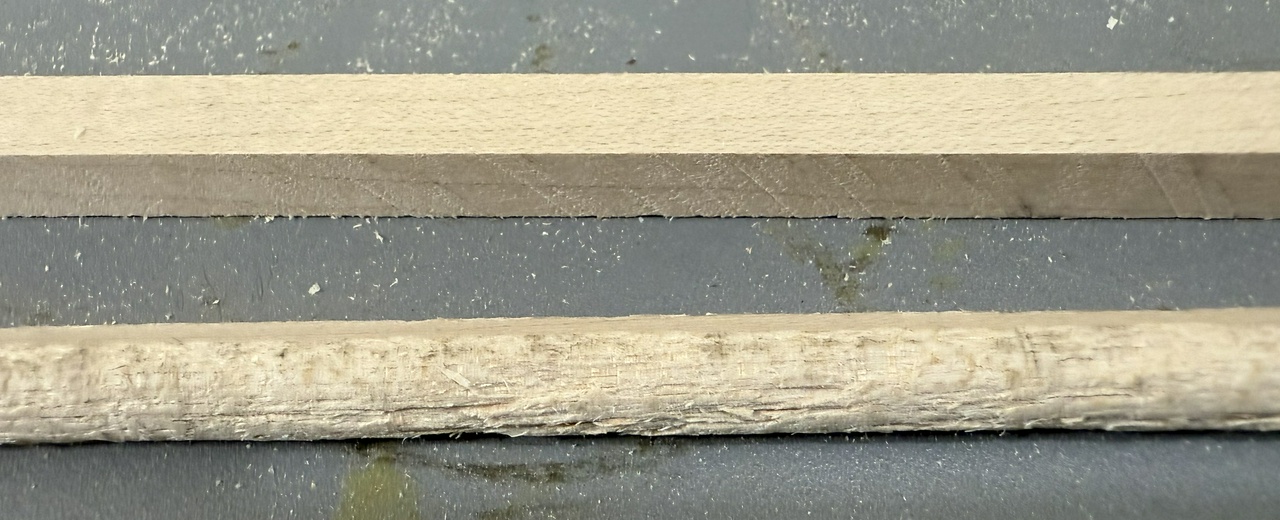
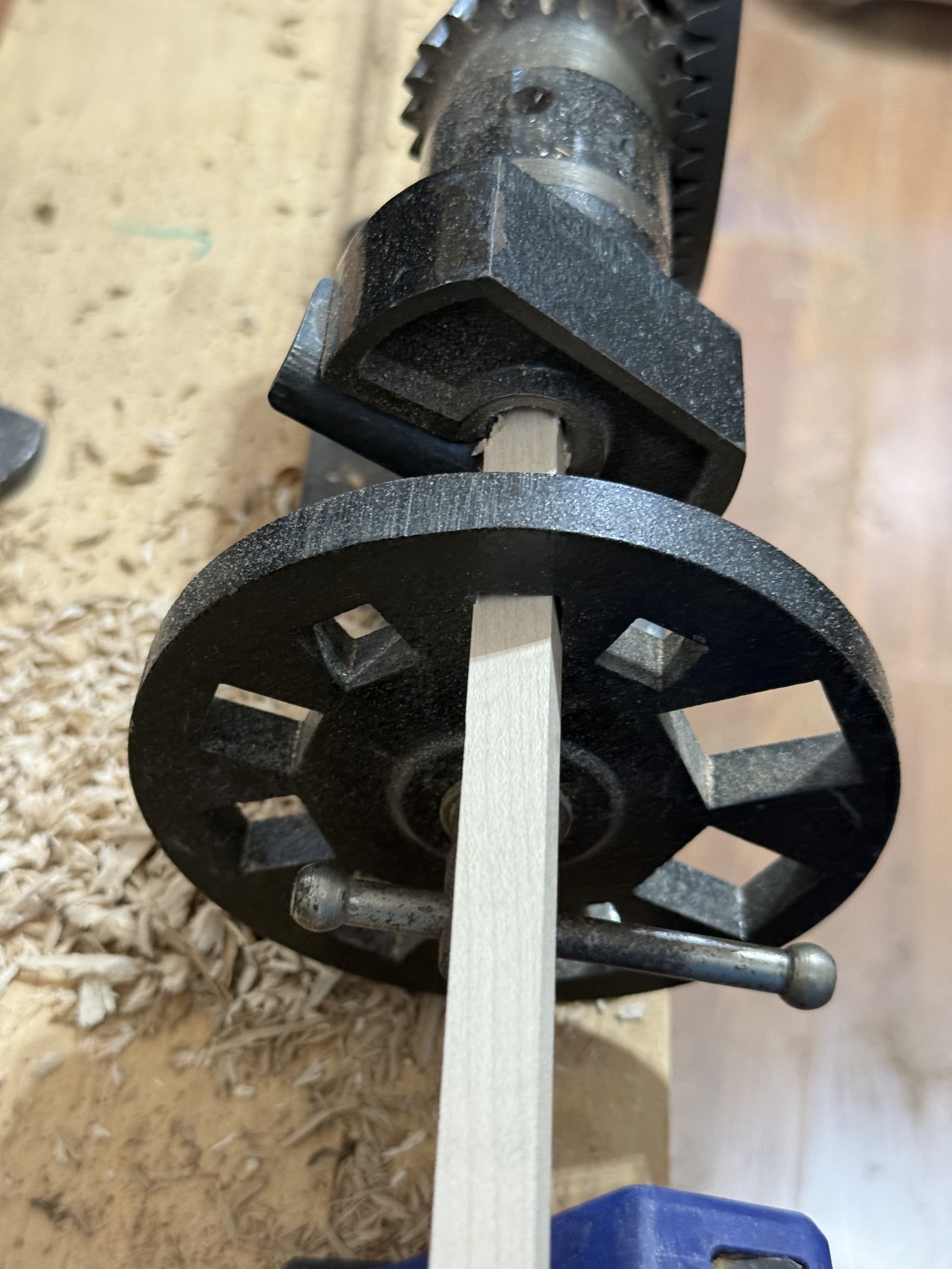
Then I run the square sticks through my Stanley 77 dowel-maker with the ⅜ inch cutter, which is set a little oversized. It produces dowels about 13/32 inch (or 1/32 inch. oversized). If you have trouble with cutting dowels, soaking them in linseed or tung oil for a while before cutting them will make them cut more easily. Just be prepared to thoroughly clean the dowel-maker if you do this, as it will get oil everywhere and you don't want that to gum up the works when it cures.
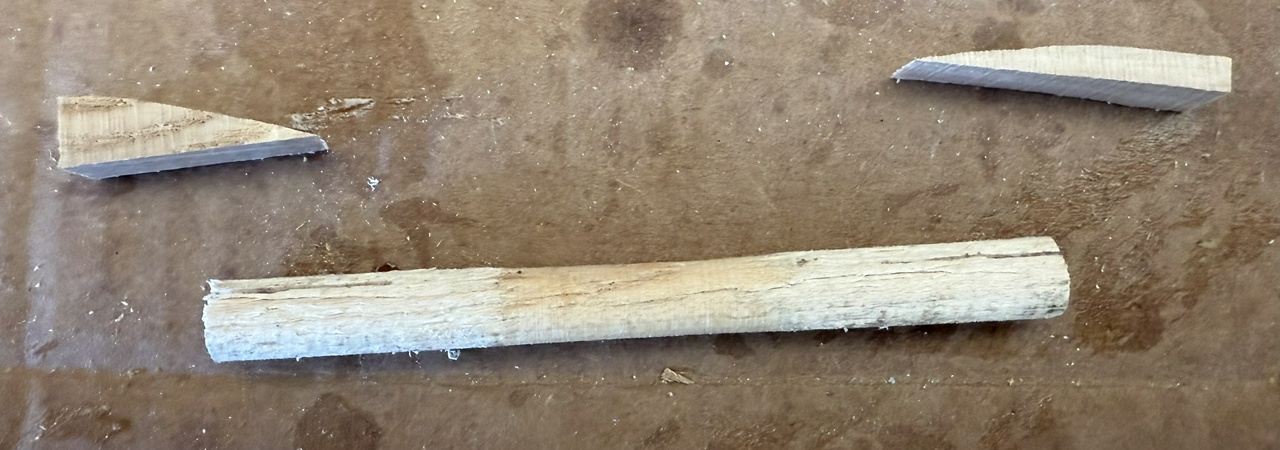
If you soaked the blank in oil, let it sit for a couple days to cure before proceeding. If there are any spots with tear-out, try to align them to the part of the axle that will be glued into a wheel, and feel free to fill it with wood filler if it makes you feel better.
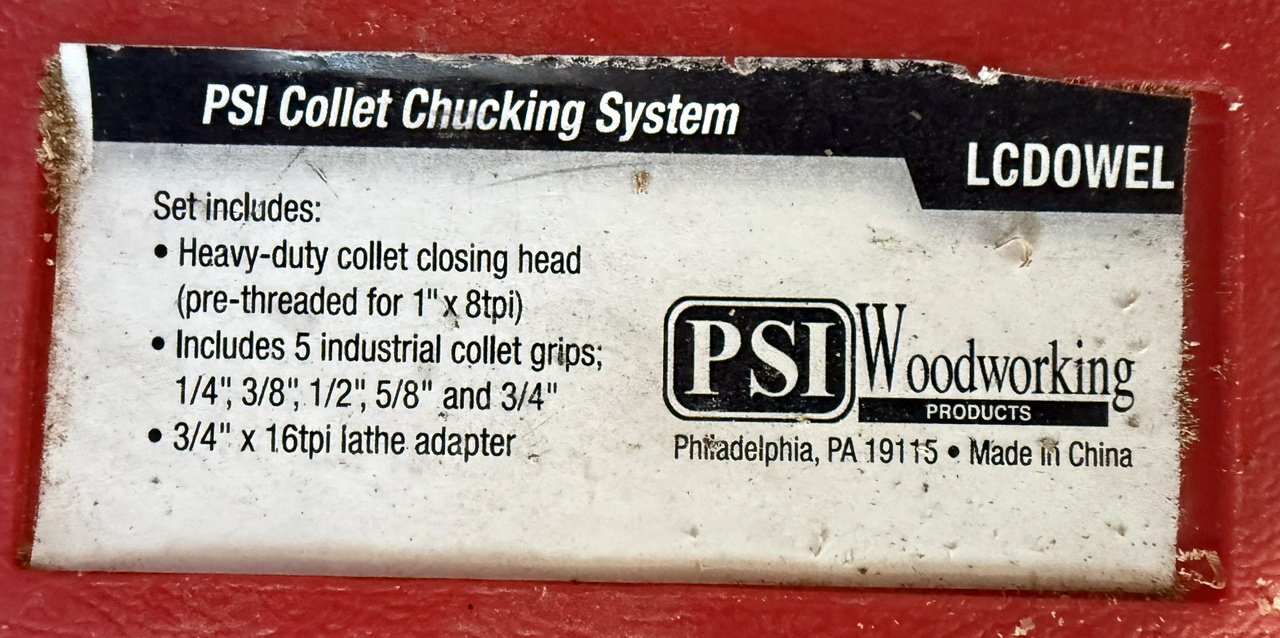
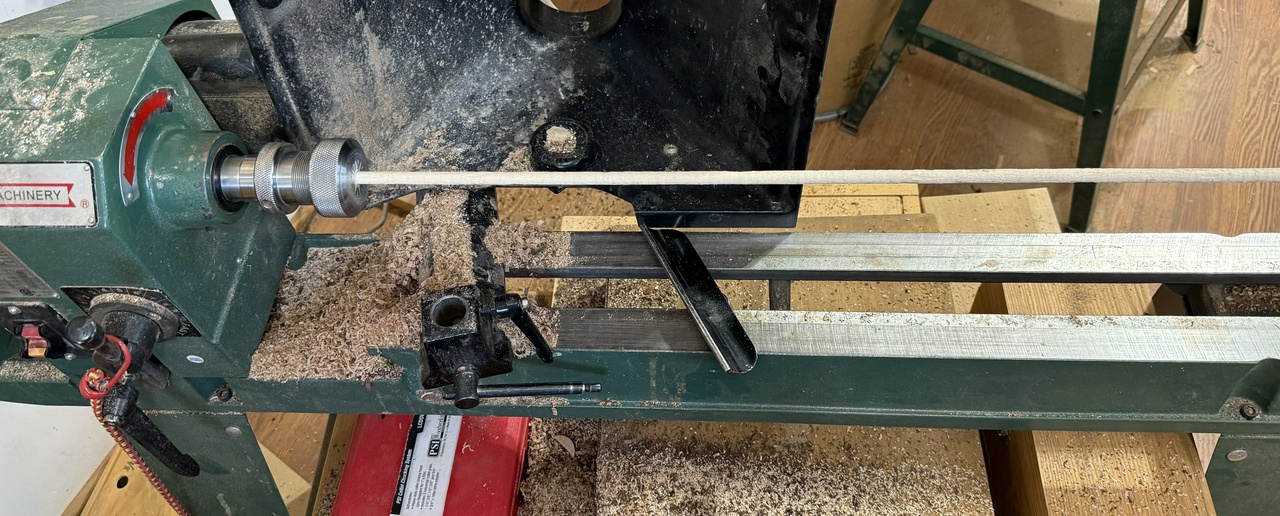
Next, I pop the rough dowel into a ⅜ inch collet-chuck on my lathe, and smooth the rough dowel with some 60 grit sandpaper, just lightly so I don't give myself any splinters. This also makes the dowel fit tightly into a hole drilled by my ⅜ inch drill bit. The dowel is either dead-on ⅜ inch at this point, or maybe 1/64 oversized.
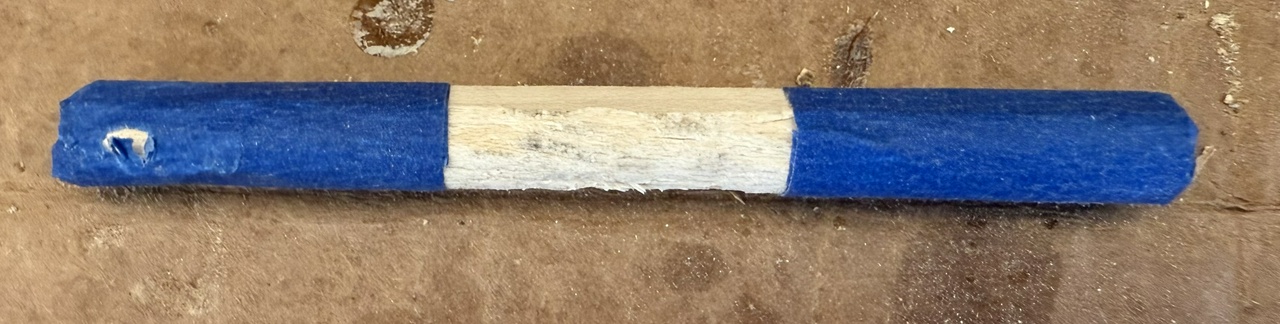
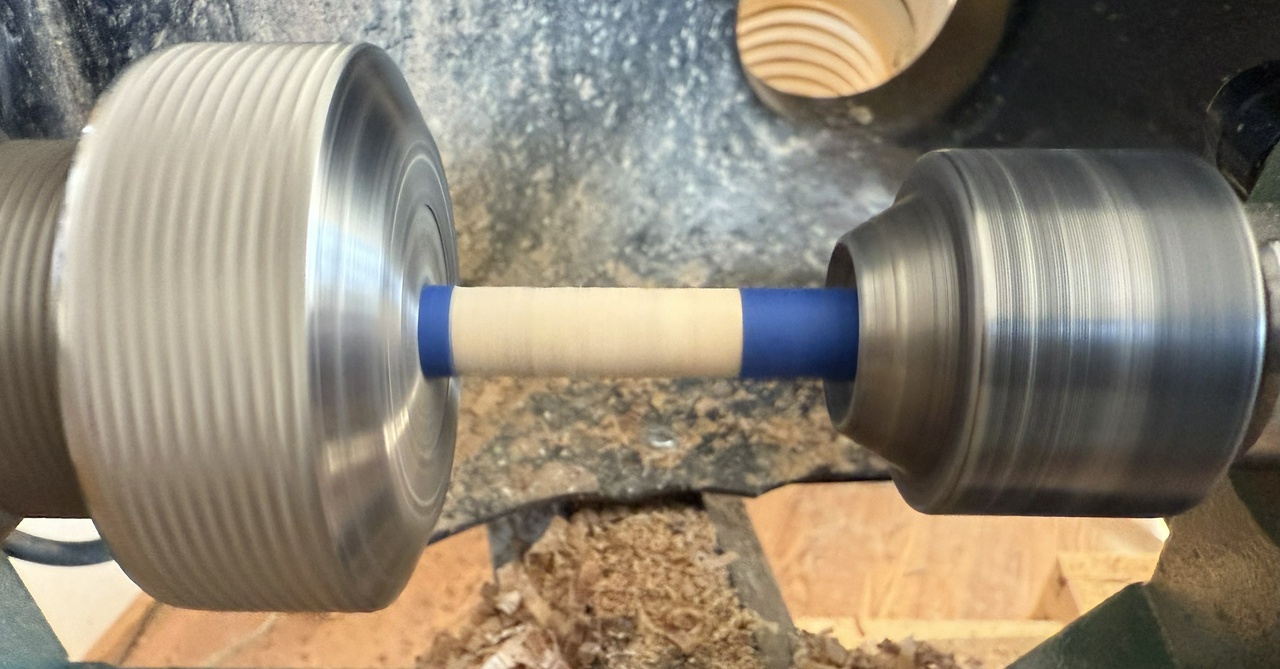
With the dowel smoothed, I cut axles to length (see more in the Assembly section), and wrap the width of the wheel on each end of the axle with blue painters tape.
I then chuck the axle up in the collet and sand the center portion down by about 1/32, making it undersized and smooth. I work through 120, 220, and 400 grits, and then apply a small amount of paste-wax to the portion of the axle without the painters tape. The paste-wax will serve as a lubricant to keep the axle turning smoothly in the body.
And there you are, a completed axle that will work well in a toy car.
It's a pretty neat tool, Duck. When I bought it, I balked at the expense, but it's been worth every penny over the years since, especially once I learned how to set the cutter depth just so, and get the cutter slightly skewed, so it makes cleaner cuts.
The price of the Stanley dowel maker has gotten crazy over the last several years. One with a full set of the cutters will run you $1000+ on eBay and it is not unusual to see individual cutter heads priced between $150 and $250 each. Most of the listings come with just a single cutter (usually the 3/8" size). Heck, people are listing just empty cutter head boxes for $85-$125. At those prices, I have considered selling mine and getting the Lee Valley dowel maker.
--Nathan, TX. Hire the lazy man. He may not do as much work but that's because he will find a better way.
FWIW, I have a couple of these from Lee Valley and they work absolutely great once set up. I’ve been very happy with them. They aren’t as sexy as the Stanley job, but then I don’t need $1000 worth of custom dowels cut!
Ryan/// ~sigh~ I blew up another bowl. Moke told me "I made the inside bigger than the outside".
Yeah, Nathan. The prices are pretty high. As soon as I tried mine, I jumped on eBay and immediately got the even sixteenth cutters, and even back then, they weren't cheap, but I figured they weren't going to get any cheaper, either.
The veritas dowel cutters work ok, but it's easier to get a dowel that isn't completely straight if you're not careful. Having the guide on the Stanley so the raw stock goes in straight does make a difference. And both are super-sensitive to setup. On the Stanley, you need to skew the blade within the cutter a hair to get the cleanest cuts.
All that said, I probably won't ever sell mine. I find myself pulling it out to make a handful of dowels a few times per year, and I really like being able to crank out some dowels from whatever wood I want, rather than being stuck with the one or two species offered at the store. And I find I don't really miss the odd sixteenths, since I can always sand a dowel down by a sixteenth pretty quickly on the lathe if I need an odd size.
I got lucky and stumbled upon a Stanley with a full set of cutters for $200 right before the prices really exploded. I almost broke a finger clicking the buy it now button on ebay before someone else got it. It had a couple of broken cutters but fortunately I found someone making replicas and got a few replacements. Unfortunately, they are no longer in business. It is a little fiddly getting the cutter dialed in just right with accurate sizes (close anyway) and with the long gaps between using it, it sometimes takes a couple of practice pieces to get it cutting cleanly without a lot of tearout.
--Nathan, TX. Hire the lazy man. He may not do as much work but that's because he will find a better way.
Yeah, getting them dialed in can be fiddly, but I also found a few blades from the folks who were making replacements. I should be good for the rest of my life.
For the 3/8 cutter, I have it set a hair thicker than 3/8 so I can sand the dowels down to size, even if there's some tearout, but after a few times using it, I got it skewed just a little, and got much better cuts, and told myself not to mess with that one again until it's time for a sharpening.
As for the long gaps, I get that too. That's why I usually will make a few extra of any size dowel I need for a project, wrap one end with painters tape with the size and wood written on it, and then stick it into a piece of PVC sewer pipe that was left over when they installed the sink in my shop. When I need a dowel, that's the first place I check, and often, I find something that'll work and don't have to pull out the 77.
I used to turn all my cutoffs into dowels using my Lee Valley cutters. It made more sense than just tossing them…at least the ones that had correct grain orientation and were long enough to matter. I had a bunch of maple, mahogany and walnut. Then I found I didn’t really need as many as I, for some reason, though I would and so I stopped doing it. Still a great plan though!
Ryan/// ~sigh~ I blew up another bowl. Moke told me "I made the inside bigger than the outside".