

Share your craft projects
Make new craft buddies
Ask craft questions
Blog your craft journey

Ron Stewart
963 posts
and
24 followers
in almost 4 years
in almost 4 years
Scrap Lumber Rack for a Tricky Room #1: Motivation and Initial Design Concepts
This is
part 1
in a
8 part
series:
Scrap Lumber Rack for a Tricky Room
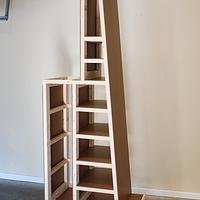
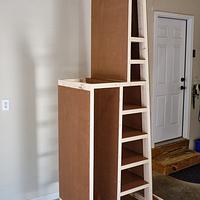
Before I start, I want to make something clear. It’s almost all Barb’s (BB1’s) fault. :-) Before I read her post Wood storage post, I was perfectly unhappy with my scrap lumber storage. The Small Scrap Lumber Cart I built years ago was always full, and I had more offcuts in a plastic tub and longer pieces leaning against the back wall along with two old cafeteria tables I no longer use.


Barb’s post introduced me to Matthew Peech’s lumber rack. It had some intriguing features, and I couldn’t stop thinking about it. I thought a smaller version of it would let me consolidate my scrap pieces and help declutter the storage room.
Before I started designing my version, I modeled the storage room in SketchUp. It’s a long, narrow room (14’ x 6’) with a tall (10’) ceiling. It has a utility sink in the corner and wire shelves on one long wall. The wall opposite the shelves has a long hanger for brooms, rakes, and other yard tools. (I didn’t bother modeling any of that. I also didn’t model wire shelves on the short wall opposite the sink wall.) The room also houses a tool cabinet and several floor-standing shelving units. Another unusual thing about this room is that it has a roughly 4” x 4” ledge running along the floor on the left side of the room. That wall is the house’s back wall, and the ledge is part of the foundation and sill plate.


I thought that the open space on the short sink wall would be a good place to place a new storage rack. Even though it was narrow, it was the only place that gave me access to the room’s full height.
If you’re not familiar with Matthew Peech’s lumber rack, here’s what it looks like. It uses tilted frames and braces to hold dimensional lumber and sheet goods of various lengths (8’, 4’, and 2’). It also has a few horizontal shelves for holding offcuts. It’s designed to fit into rooms with 8’ ceilings. It’s also big: 6’ long, 3’ wide, and 7 1/2’ tall.

I designed a smaller version of it that I thought would work in our room.


Here it is in the room model. Getting long boards and sheet goods in and out of the sloped front shelf would be awkward, but it seems like I could angle them in and out. (I’d have to remove the support arms shown in the model.) I’d paint or poly the back of the rack because water would splash on it.

Then I showed the model to my wife, and we went to the actual room so I could show her where it would sit. (She tends to find looking at SketchUp models unhelpful. Prototypes and general real-world hand waving help her more.) She didn’t think it was workable. The biggest problem was that she doesn’t stand directly in front of the sink when she uses it (partially because my Work Mate folding workbench and some buckets were on the floor in front of the sink, off to the right). Even if she could stand directly in front, she needed some clearance on the left to swing filled buckets of water or watering cans out of the sink. She also pointed out that my rack design didn’t allow for good storage of long (say 48”), narrow offcuts.
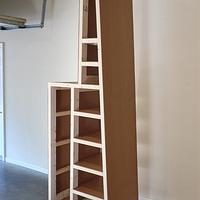
All of that meant the mini-Peech design was out, and I started working on concepts that would leave some empty space beside the sink. That meant tall, narrow designs, and they don’t hold much. When I was almost ready to abandon the project, I came up with the idea of lowering the back part of the rack so it could fit under the bottom shelf, and having it roll forward when I needed to access that part. Here are some of my conceptual models. The one on the right is closest to the final design, which I’ll cover in the next post.

5 Comments

Haha...glad to spread the joy.
Yours is very well designed!
Yours is very well designed!
😀 I am glad that you caused me to start thinking about it, and thanks.
So far, so good. Let's see what's next.

I love seeing the compressed design evolution.
Thanks, Ross.
