




Share your craft projects
Make new craft buddies
Ask craft questions
Blog your craft journey

Ron Stewart
963 posts
and
24 followers
in almost 4 years
in almost 4 years
More from Ron Stewart


Scrap Lumber Rack for a Tricky Room
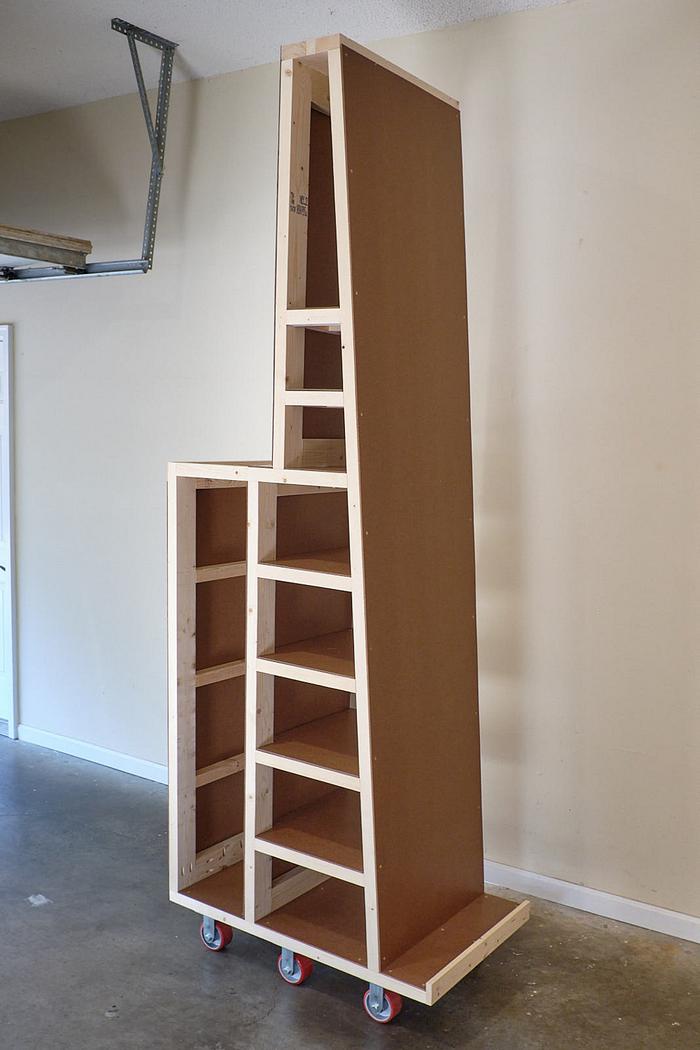
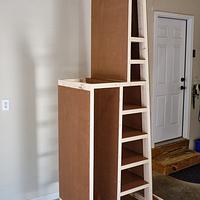
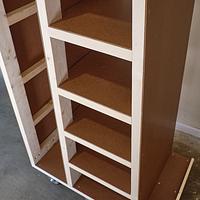
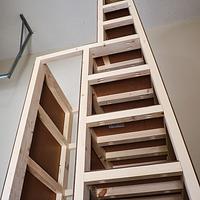
This is a rack I just built to hold scrap wood (lumber and sheet good offcuts). I designed it to fit at the back of a narrow (6’ wide) storage room next to our garage. To make things worse, there’s a utility sink on the short back wall where I needed to put the rack, and there are wire shelves running along the long adjacent wall (behind the rack), so space is very limited. Fortunately, the room has a 10-foot ceiling, so I had plenty of vertical space.
My rack was loosely inspired by Matthew Peech’s Easy DIY Lumber Storage Solution For ANY Garage and by Barb’s (BB1’s) variation of it. Initially, I planned to use a smaller version of his rack, but it would have butted up right to the side of the sink (as if the sink were in a small alcove). That setup wouldn’t work for my wife. She tends to stand at the corner of the sink instead of directly in front of it, and she needs some clearance on its left for moving buckets or watering cans. It also had some other issues, so it wouldn’t work out after all.
I sketched out a few other variations before settling on the design I built. It’s 39” wide, 24” deep, and about 8 1/2’ tall. It provides four types of storage for various types of scraps:
My rack was loosely inspired by Matthew Peech’s Easy DIY Lumber Storage Solution For ANY Garage and by Barb’s (BB1’s) variation of it. Initially, I planned to use a smaller version of his rack, but it would have butted up right to the side of the sink (as if the sink were in a small alcove). That setup wouldn’t work for my wife. She tends to stand at the corner of the sink instead of directly in front of it, and she needs some clearance on its left for moving buckets or watering cans. It also had some other issues, so it wouldn’t work out after all.
I sketched out a few other variations before settling on the design I built. It’s 39” wide, 24” deep, and about 8 1/2’ tall. It provides four types of storage for various types of scraps:
- A sloped front wall (tilted back five degrees from vertical) holds long sheet good offcuts and, occasionally, a full-length board or two.
- A tall, unstructured bin at the back holds long (up to 52”) scraps.
- A tall, narrow shelf at the top holds short (up to 25” long x 24” wide) sheet good scraps.
- Seven horizontal shelves hold smaller, shorter (up to 24”) scraps.
The bin for long offcuts nestles under the room’s lower wire shelf when the rack is stowed. In that position, I have full access to the sloped front and horizontal shelves, and the rack is far enough from the sink to let us use it. When I need to access the long-offcut bin, I roll the cart forward about a foot. (I’ll need to relocate those roller stands; they’re going to get in the way.) When stowed, the rack limits access to the last two feet of the wire shelves, so we store seldom-used items there.

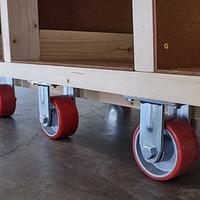
For that dual-position approach to work, the rack must roll easily, smoothly, and straight. To ensure that, I mounted it on six large, fixed casters. I found heavy-duty ones on clearance at Grizzly.com for less than $8 each, so I ordered six. They’re Steelex D2554 fixed casters without brakes. (I’m not providing a link because I assume the product page will soon disappear from their website.) The wheels are 4” in diameter and 2” wide, with a weight capacity of 550 lbs. per caster. I wish I had ordered one with a brake to place at the near front corner, because the floor slopes down slightly toward the sink, and the rack tends to roll forward. For now, I just use a block of wood as a chock to keep the rack in place. If it ends up being a nuisance, I’ll fabricate some type of flip/sliding stop.
To save money, I decided to use construction lumber and hardboard instead of plywood. The rack required fourteen 2x4’s and two sheets of 3/16” thick hardboard. (I had intended to use 1/8” hardboard, and it would have worked just as well and saved me $20. I just didn’t pay close attention when I bought the sheets and didn’t notice my mistake until after I had the sheets cut in half to fit into my car.) I used pocket holes (almost 300!) to assemble the frame and 1-1/4” construction screws to attach the hardboard panels. The total cost ended up around $200, which is more than I had hoped, but not too bad considering the high cost of everything these days.
I discarded a few scraps (enough to fill two small shipping boxes), but I managed to fit the rest into the rack. While loading it, I noticed a few issues I still need to address. First, I’ll probably need to add some dividers to the long-offcut bin to organize and secure the scraps there. Second, I realized that a lot of my scraps are short. That’s good, because they will fit on the shelves. It’s also bad, because storing short scraps on a 24” deep shelf either wastes space or requires storing some scraps behind others, which makes them hard to find and access. To address that, my wife found these trays on the web. They’re 24” deep and 4” tall. I plan to store my short scraps in them, and they’ll sit beside or above longer scraps on the shelves. I think they’ll be very useful, sort of like deep drawers.

The long scraps stored on the right side need to be protected from water splashes from the sink. For now, I’m covering them with a 24” x 48” piece of hardboard. I also considered adding some type of bungee-fastened tarp wrapping from the back frame around to the front, or a tarp anchored at the top of the rack and extending down to the rack’s front lip. I’ll see if the hardboard piece is sufficient, though.
Time will tell if this rack is an improvement over my old setup. At the very least, it enabled us to reorganize the storage room and free up some shelf space. I’m convinced that there’s no perfect one-rack solution, but I tried to come up with the best compromise that works for me. I think the real answer is my being more selective about which scraps I keep.
For more background, design, and construction details, please see the corresponding blog series and the SketchUp models of the rack and the room at 3D Warehouse. (As with all of my models, it's best to navigate the model by viewing different scenes--Scenes > My Scenes inside the SketchUp viewer.) Thanks for reading!
18 Comments

Fills the need nicely.
Ron

Looks like a great fit for the space! Pocket holes work...but wow on 300!!
I recommend creating a note for items on the shelves. I just used blue tape and a marker so I would know how long/wide boards were along with the type of wood. Saves time pulling a short board only to find out to it is too short/narrow.
I recommend creating a note for items on the shelves. I just used blue tape and a marker so I would know how long/wide boards were along with the type of wood. Saves time pulling a short board only to find out to it is too short/narrow.
Thanks, Ron! (Cool name, BTW 😀)
Thanks, Barb! Yes, I ended up using two screws on the end of each 2x2 brace, which made the screw count explode. I saw the blue tape labels you used. I like the idea, but I’m not sure I’ll have the discipline to add the labels. Right now, I have different species or wood types on different shelves (more or less). I’m not sure if that’s the right way to go, though.
Thanks, Barb! Yes, I ended up using two screws on the end of each 2x2 brace, which made the screw count explode. I saw the blue tape labels you used. I like the idea, but I’m not sure I’ll have the discipline to add the labels. Right now, I have different species or wood types on different shelves (more or less). I’m not sure if that’s the right way to go, though.

That sure is handy. Soon you will find out it needs to be bigger!!!!
Cheers, Jim ........................ Variety is the spice of life...............Learn something new every day


Cool "cabinet"... too pretty for the workshop. I could envisage it as an artisan book case... though with the amount I read, one shelf would be an over kill.
If your first cut is too short... Take the second cut from the longer end... LBD
I’m not sure I’ll have the discipline to add the labels
I don't always do a good job keeping up with the plywood cutoffs - although when I do, I appreciate it when I am searching for a certain size. I have a bunch of bins sorted by wood type too (I can't throw out cutoffs that might find a use in the future!).
Well, it came together nicely, and the writeup was interesting.

well done for the space man ! space..........the final frontier..........................
working with my hands is a joy,it gives me a sense of fulfillment,somthing so many seek and so few find.-SAM MALOOF.
Great use of your available space!
Ryan/// ~sigh~ I blew up another bowl. Moke told me "I made the inside bigger than the outside".

Ron, you're overloading my brain with the simultaneous posts of project and build blog! I'll need to settle-in for a good read with a bowl of popcorn.
What a well thought-out rack for the available space and usability requirements. It's very sculptural. I would think it would evoke a smile every time you walk in the room. Great work, Ron, as always.
What a well thought-out rack for the available space and usability requirements. It's very sculptural. I would think it would evoke a smile every time you walk in the room. Great work, Ron, as always.

Fantastic planning and final product Ron!
Seems like a simple goal, make a rack to store cutoffs, but it is all the seemingly small details that make it really functional.
I found the way you considered the rooms layout priceless!
Seems like a simple goal, make a rack to store cutoffs, but it is all the seemingly small details that make it really functional.
I found the way you considered the rooms layout priceless!
Thanks for the comments, everyone.
Jim, I certainly hope not! I think this is the most space I can allocate. I will need to get better about tossing small scraps after each project.
Oldtool, thanks for reading and commenting on the entire blog.
Sorry about the data dump, Ross. I tend to gather up all my photos right after I finish a project, order and rename them to form an outline, and then do all the writing over a few marathon sessions. After that, I’m ready to move on, so I post everything at once. I do like how it looks.
LBD, yeah, it’s overkill for an art display. It’s probably overkill for the amount of wood it can hold, but 2x4s are cheap(ish), so I used them liberally.
Splint, we have a lot of stuff jammed into that room, and I learned a lot about how my wife uses that sink in the planning process.
Jim, I certainly hope not! I think this is the most space I can allocate. I will need to get better about tossing small scraps after each project.
Oldtool, thanks for reading and commenting on the entire blog.
Sorry about the data dump, Ross. I tend to gather up all my photos right after I finish a project, order and rename them to form an outline, and then do all the writing over a few marathon sessions. After that, I’m ready to move on, so I post everything at once. I do like how it looks.
LBD, yeah, it’s overkill for an art display. It’s probably overkill for the amount of wood it can hold, but 2x4s are cheap(ish), so I used them liberally.
Splint, we have a lot of stuff jammed into that room, and I learned a lot about how my wife uses that sink in the planning process.

Tucks away nicely, and allows for a good amount of scrap wood. Win win. Nice build.
Thanks, George.

Nice project and blog. Both are well done🙂
This is interesting.
Petey

Great storage Ron. It looks like it goes forward and can also go backwards. When it under full load how do you make it go sideways? Drag it?
Dr. Quackner
Thanks, Steve, Petey, and DrQuackner!
DrQuackner, you’re right. It will only roll forward and backward. I hope I never need to move it sideways when it’s loaded, but you’re right—if I do, I’ll have to drag it.
My initial inspiration was the wheels on my wife’s elliptical exerciser. Its wheels are concave and ride on tubes. I thought some like that would be perfect to keep the rack from veering into the wall and scratching it. I couldn’t find anything like that in my brief web searching. (Even if I had, I bet it would be expensive.) so I chose casters.
I had planned on capturing the casters against the wall in a track formed by two parallel boards (with a front stop block to keep the rack from reaching the sink). I’m not sure I’ll need it, though.
DrQuackner, you’re right. It will only roll forward and backward. I hope I never need to move it sideways when it’s loaded, but you’re right—if I do, I’ll have to drag it.
My initial inspiration was the wheels on my wife’s elliptical exerciser. Its wheels are concave and ride on tubes. I thought some like that would be perfect to keep the rack from veering into the wall and scratching it. I couldn’t find anything like that in my brief web searching. (Even if I had, I bet it would be expensive.) so I chose casters.
I had planned on capturing the casters against the wall in a track formed by two parallel boards (with a front stop block to keep the rack from reaching the sink). I’m not sure I’ll need it, though.
More from Ron Stewart
