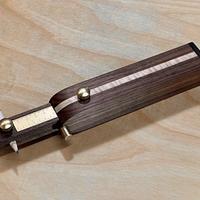
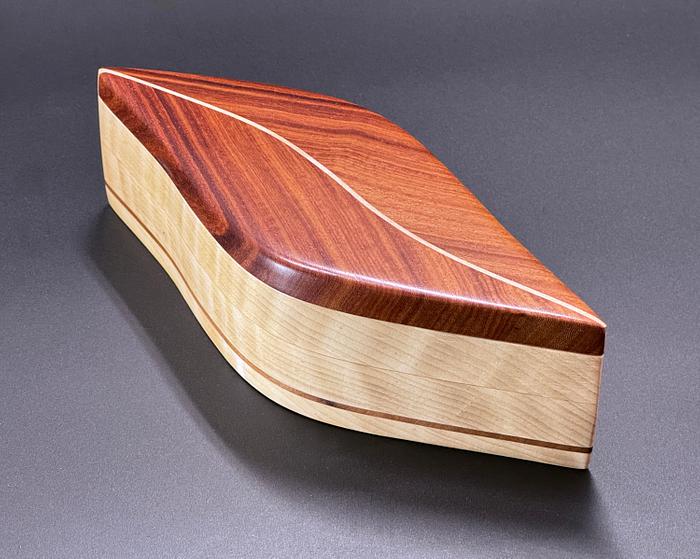
I first saw this box several years ago, and was inspired to finally make one by Pottz’s beautiful box he posted a few weeks ago. I wouldn’t bother posting mine except for the challenge presented in making the leaf lid without a CNC. Like Pottz, I recently purchased a benchtop spindle sander which helped greatly. Speaking of Pottz, I heard from a reliable source that he DJ’s at a local club under the name Sir-Pottz-A-Lot. But I digress…
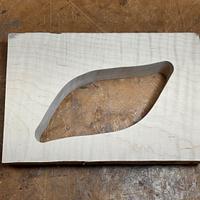
I started by drawing the shape using Bézier curves on my computer, and printing out several copies at my desired size. The overall shape of the interior was transferred to some maple for the body of the box. I drilled 1/2” holes with a Forstner bit on each end since that’s the smallest size of my spindle sander, and roughed out the rest with my jigsaw. Finished up with the spindle sander, what a useful tool. Come to think of it, that’s what my wife calls me.
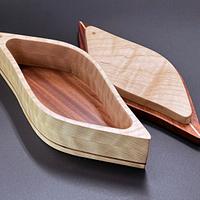
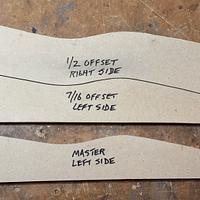
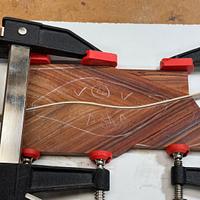
Building the lid proved to be somewhat challenging in order to fit the 2 halves together with a 1/16” “stem” down the middle. If the 2 halves are made using the same template and flush trim bit they will not fit perfectly together. I’ve made cutting boards with 1/4” curved insets before using a template with a flush trim router bit, but as far as I know there aren’t 1/16” flush trim bits available. My solution was to first make a master template from my drawing for the shape of the stem. I then made 2 more templates from the master using a 1/4” down cut spiral bit ( the size doesn’t matter as long as its the same for both), one with a 7/16” guide bushing and one with a 1/2” guide bushing. These 2 secondary templates were used with a flush trim bit to make the 2 halves of the lid. With a strip of 1/16” maple down the center, the lid halves fit together perfectly. Miracles do happen.
I originally thought about using some figured Walnut for the lid, but found a beautiful piece of Pau Rosa at my local Woodcraft. It’s a dense, tight grained wood from Africa, very heavy. Also expensive, but I only needed a small piece. Most of my projects are finished with Osmo Polyx, but I wanted a bit more sheen so went with wipe on poly, a finish that I’m liking more all the time. Thanks for looking.
Beautiful box, great use of woods. The addition of the contrasting woods really sets the colors off.
Note that "Woodsmith" does a similar box, and makes their nesting lid, and inset bottom by cutting out the plug shape, then slicing off the tabs for both lid and bottom and then regluing them. Following a tip I got from Alex Snodgrass I don't sand these parts prior to regluing them. I made a bunch of these several years ago, and as gifts they were the most commented on of anything I ever made.
Nice job on that Foto! The sanding on the lid is impeccable!
I've made the inlay style cutting boards like that before but went a bit different. Hate using the router collars, even on my router table so I made a template for one side of the curve and taped that down to the stock. Then with a bearing-on-the-shaft hinge mortise bit (3/8 diameter, 3/8" depth or something with a diameter equal to the width of the intended inlay). I raised the bit to follow the template (template side down on the table) and cut a 3/8" wide slot in the wood about 1/4" deep. If you use thicker template stock you can use a longer template bit if you don't have a mortise bit. Cut down the slot center line with a band saw then return to the router table and use whatever template bit to have its bearing follow the "clean" edge left by the initial routing. This makes for a perfect fit when the inlay is added and clamped in place. If the curve isn't too severe, you can get away with a thinner inlay and still not have gaps. I found that I had to make the inlay from 1/8" strips and laminate them together to allow them to be bent before gluing up the whole assembly.
beautiful FD, now thats what i started to do but when i didn't have any wood with a grain i wanted i just went the way i did and lazered my wifes name. well done.
working with my hands is a joy,it gives me a sense of fulfillment,somthing so many seek and so few find.-SAM MALOOF.
Thanks all for the nice comments. Pottz, I think the lasered name looks great on your box with a single piece of wood. It would probably be too distracting if you had the leaf pattern.
Splinter, that’s the exact technique I have used before for cutting boards and it works great for insets that are the same size as the router bit. But the radius’s (radii?) will be slightly different if the inset piece isn’t the same width, and in my experience there were tiny gaps when I tried it that way. I don’t know, maybe you have stronger clamps than mine?😄
Duckster…okay I lied, I didn’t really use Bézier curves, I just tried drawing straight lines after a couple of rounds of my favorite Irish whiskey, and this is what came out.
Oh, I forgot to add, if anyone is wondering about the dots on the body and lid, those were added to show the proper orientation. There’s a very slight difference between the curves after all the sanding, so the lid fits perfectly in this way.