


Share your craft projects
Make new craft buddies
Ask craft questions
Blog your craft journey

Fotodog
187 posts
and
10 followers
in over 2 years
in over 2 years
More from Fotodog
Marking Gauge for curves
Greetings fellow craftspeople,
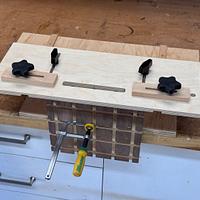
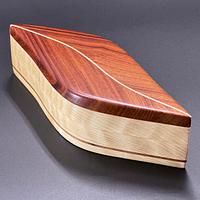
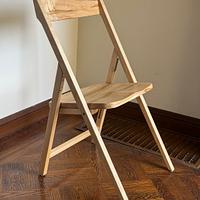
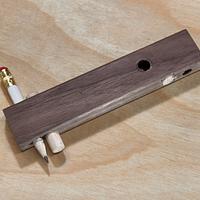
I recently built a leaf box which required scribing a line 3/8” away from a curved edge. The fancy marking gauge that I built last year works great for straight edges, but is useless for tight curves. For my project I made a quick temporary guide by inserting a dowel into a piece of wood and drilling a hole to hold a pencil with a friction fit the correct distance to produce a 3/8” offset. It worked well but was not adjustable, so basically a one time use. Photo is enclosed.
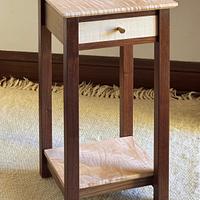
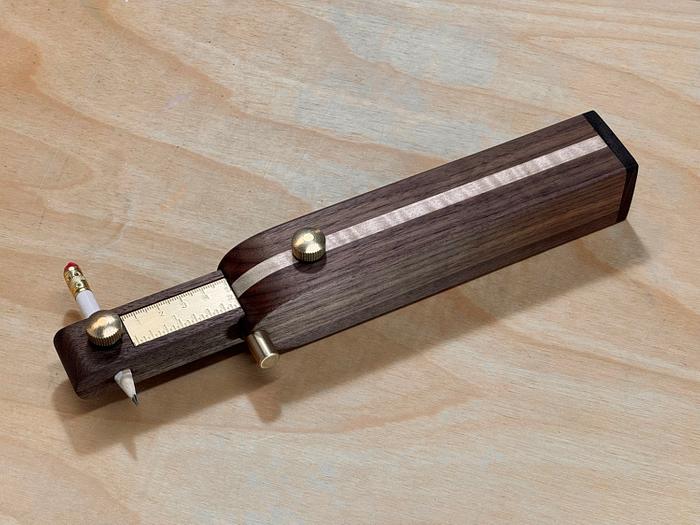
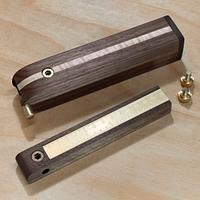
After warming up my brain with enough Pinot Noir, I eventually came up with this design. It’s based on the same principle as my temporary one, where a round dowel rides against the curved edge with the pencil held a given distance away. I ripped a piece of walnut in half, added a piece of maple to one half, and routed a groove down the center of both pieces. Once glued back together, this creates the opening for the center shaft which holds the pencil. I added a thin piece of Wenge to cover the back, because a shop project just isn’t complete without some Wenge. Brass threaded inserts were added to hold the knobs. Lastly, a small brass ruler was inset, making small incremental adjustments in the routed slot until it was dead on accurate.
I was initially planning on this gauge being smaller, but the width and height were determined by several factors, starting with the center shaft. Its width of 7/8” is determined by the width of the pencil, plus enough extra to allow for the brass insert (1/4” both sides). It needs to be tall enough so that the knob tightens against a flat portion of the pencil, not the sharpened part, so I made it 1 1/8” tall. The outer piece also needs enough room for the second brass insert, so I added 1/4” all around to produce the 1 3/8” x 1 5/8” final dimensions. As it turns out, once the edges are rounded over, it’s very comfortable in your hand. It’s now my go-to marking gauge.
I recently built a leaf box which required scribing a line 3/8” away from a curved edge. The fancy marking gauge that I built last year works great for straight edges, but is useless for tight curves. For my project I made a quick temporary guide by inserting a dowel into a piece of wood and drilling a hole to hold a pencil with a friction fit the correct distance to produce a 3/8” offset. It worked well but was not adjustable, so basically a one time use. Photo is enclosed.
After warming up my brain with enough Pinot Noir, I eventually came up with this design. It’s based on the same principle as my temporary one, where a round dowel rides against the curved edge with the pencil held a given distance away. I ripped a piece of walnut in half, added a piece of maple to one half, and routed a groove down the center of both pieces. Once glued back together, this creates the opening for the center shaft which holds the pencil. I added a thin piece of Wenge to cover the back, because a shop project just isn’t complete without some Wenge. Brass threaded inserts were added to hold the knobs. Lastly, a small brass ruler was inset, making small incremental adjustments in the routed slot until it was dead on accurate.
I was initially planning on this gauge being smaller, but the width and height were determined by several factors, starting with the center shaft. Its width of 7/8” is determined by the width of the pencil, plus enough extra to allow for the brass insert (1/4” both sides). It needs to be tall enough so that the knob tightens against a flat portion of the pencil, not the sharpened part, so I made it 1 1/8” tall. The outer piece also needs enough room for the second brass insert, so I added 1/4” all around to produce the 1 3/8” x 1 5/8” final dimensions. As it turns out, once the edges are rounded over, it’s very comfortable in your hand. It’s now my go-to marking gauge.
15 Comments
I love it when tools are not just functional, it also beautiful. Fantastic!

sweet !
working with my hands is a joy,it gives me a sense of fulfillment,somthing so many seek and so few find.-SAM MALOOF.


That's what I call
If your first cut is too short... Take the second cut from the longer end... LBD

What an incredibly beautiful tool!
Foto
That is beautiful. You got me with the Wenge thing.
That is beautiful. You got me with the Wenge thing.
Petey

If it works, solves the problem, and is good looking it is a great tool. Choice of materials and finish aides in the great tool category.
Believe yours hits all the items.
Believe yours hits all the items.
Ron
If it works, solves the problem, and is good looking it is a great tool.
Ron, are you talking about the marking gauge or me?🤪 Thanks everyone for the nice comments.
Looks awesome.

Stunning piece of kit!

Wow - that looks amazing!

Beautiful and very useful tool .Nice work on it!!!!!!!!!!!!!!!!!!!!!!
Cheers, Jim ........................ Variety is the spice of life...............Learn something new every day

A very functional and well designed tool!!!

That's a handsome tool. Projects are bound to turn out great using a gauge like that! 😃
Thanks everyone!
I've got quite a few marking/mortise gauges. Now I think I need another one. LOL. Nice work sir!
Andy -- Old Chinese proverb say: If you think something can't be done, don't interrupt man who is doing it.
More from Fotodog
