There’s a cool place in Huntsville (Alabama) called Lowe Mill Arts & Entertainment. It’s an old textile mill that has been converted into a space for artists and makers of all sorts. The shops there sell goods, but many of them are also working studios, and the creative people there are always willing to talk. Lowe Mill also contains performance spaces, eateries, and even an arcade with vintage pinball machines and video games. It’s an unexpectedly artsy place in a city known more for engineers and other tech workers.
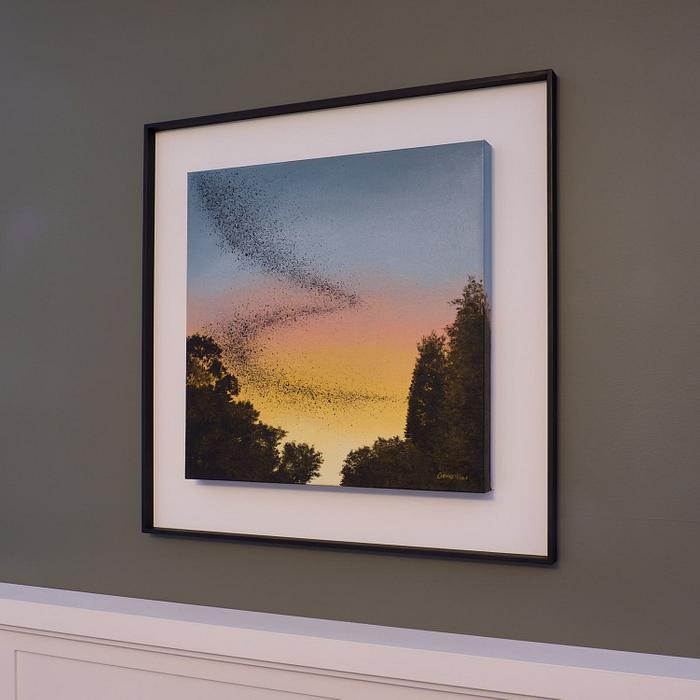
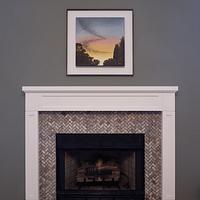
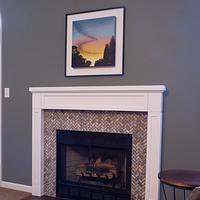
Our favorite local artist has a studio there. Her name is Corinna Nicole, and most of her paintings are inspired by murmurations, large swarms of starlings that swirl and shift in the sky. My wife and I have always been drawn to her work, and we’ve always wanted to find a spot for one of her paintings in our house. Last month, we got serious about filling the large empty wall above our fireplace, and we finally bought one. It resonates with my wife because it reminds her of our first dog, Jenny, and a neighborhood park where Jenny would chase tennis balls until she was exhausted. The park is surrounded by trees, and we would see murmurations there on occasion.
The painting we bought is 20” square. It’s one of those paintings that’s on a canvas wrapped around, and stapled to, a chunky inner wooden frame that’s about 1 1/2" deep. These paintings are typically hung directly on the wall, with no visible frame. We like them because of their modern look. In our case, the painting is too small for its location, so we decided to mount it in some type of frame that would give it more size and presence on the wall.
Display Frame and Wall Mount
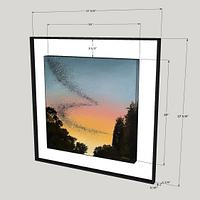
We designed a frame to provide a backdrop for the painting. We wanted to keep it minimalistic and low profile to keep the focus on the actual painting.
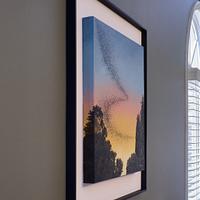
It has a 3 1/2" wide white border and thin (5/16” wide) black frame around the painting. It’s a little under 28” square, which is a better size for the wall. The outer frame projects out about an inch to give the whole thing some three-dimensionality when viewed from an angle.
I made the outer frame from poplar and the matboard from 3/16” hardboard. Before painting, I sealed everything with shellac. I used rattle can spray paint (Rustoleum Painter’s Touch 2X Flat Black) for the frame and rolled-on white paint (Benjamin Moore Super White, matte finish, paint code PM-1) for the matboard.
Overall, it was a simple project. Its most noteworthy technical aspect is the mounting system I devised. The frame was too thin for the usual screw-mounted hanging wire or serrated hangers. We didn’t want to use a wire hanger anyway, because we didn’t want it to lean away from the wall at the top.
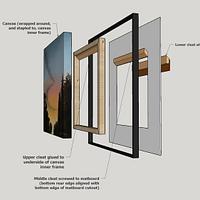
After mulling things over, I realized I could take advantage of the hollow space behind the canvas.
That space is deep enough to accommodate a pair of stacked French cleats: one for hanging the painting on the frame’s matboard, and another for hanging the matboard on the wall. A cutout in the matboard provides clearance for the wall/matboard cleat and reduces weight. The thin outer frame is purely cosmetic.
I’m hoping this is the kind of project some non-woodworker will stumble upon one day and say, “Hey, I can build something like that,” so the rest of this post includes details that most members here wouldn’t need.
I cut the outer frame sides from a piece of 4/4 poplar. I cut a shallow (1/8” wide, 3/16” deep) rabbet in each side for the matboard using two passes on my table saw and a flat top grind blade.
Then I mitered the ends and glued the sides like I was building a box—laying the sides face down on a table, taping across the corner joints, adding glue, folding it closed, and taping the final corner. I used the matboard to keep the sides square, meaning that I had to be judicious with the glue so none of it squeezed out onto the unpainted matboard. I also clamped the corners to a worktable to keep the frame flat.
Matboard
The matboard is just a big square cut from thick (3/16”) hardboard.
To provide clearance for the mounting cleat, and to reduce weight, I cut out most of the center. It was hard to see my pencil marks, so I outlined the corners with painter’s tape.
I considered using a router and edge guide to make the cutout, but I opted to use my jigsaw. Many woodworkers can cut straight lines with a jigsaw, but I’m not among them. I decided I’d drill out the corners, then use a guide board to cut between the holes.
I used some scraps to position a 3/4" Forstner bit on each corner.
I cut out a spacer board whose width matched the distance from the jigsaw’s blade to the edge of the sole plate. I aligned the spacer with the cut line and used it to position the guide board, which I clamped to the table.
I removed the spacer, then cut the line between the holes using a fine-toothed scroll blade.
The cut was very clean and smooth.
I did the same for the remaining sides. Aside from drilling the mounting holes for the cleat, I was ready to paint. The holes needed to be countersunk on the back, because the matboard sits directly on the wall.
Painting
To preserve a clean line between the frame and matboard, I painted them separately. I started by sealing everything with a few coats of spray shellac.
Before painting the frame, I taped the off the rabbet. Because it is so narrow, I had to cut strips of painters tape to match its width (which is the width of the matboard).
I rested the inside edges of the rabbet on some scraps to support the frame while I sprayed. The Rustoleum 2X paint I used went on very thick, so I had some sags and runs. I sanded them flat and sprayed another coat. It’s still not perfect, but the problems are difficult to see in the actual room, so I cut my losses and stopped.
I used a 1/4" nap mini roller to paint the matboard. The first coat showed a lot of roller texture.
I added three more coats, sanding with 320-grit paper in between. The subsequent coats looked better when wet, and they flattened adequately as they dried.
Final Glue-up
To finish the frame, I needed to glue the matboard to the outer frame. My only concern was making sure that no glue at all squeezed out onto the face of the matboard. At first, I considered dry mounting the matboard, placing the assembly face down, and running a thin bead of white glue along the joint, hoping enough would seep into the gap to hold the frame in place.
The joint was tight enough that I wasn’t convinced that approach would work, so I had to use a more conventional method. I applied the smallest bead of glue ever to the corner of the rabbet.
Then I spread the glue so it was practically invisible. It was just a thin smear.
Then I carefully dropped in the matboard. Gravity held it flat everywhere but one corner, so I used a small weight to hold it down there. The outer frame is so light that the tiny amount of glue I used was sufficient. I didn’t get any squeeze-out, so I was happy.
Mounting Cleats and Installation
To finish the project, I had to install the cleats on the matboard and inner canvas frame.
I used countersunk flat-head screws to attach the cleat to the matboard. The hardest part was making sure it was positioned correctly. I drilled some extra pilot holes in case I was slightly off and needed to reposition the cleat (in case it was rotated slightly, etc.).
(Actually, I drilled and countersunk the screw holes before I painted the matboard and attached the outer frame. It was easier that way, and there was no paint to damage. All I really did at this stage of the project was screw the cleat to the frame.)
Then I needed to add the cleat to the inside of the top of the inner canvas frame. This was by far the most nerve-wracking part of the project. One wrong move, and I’d ruin the painting. I considered predrilling angled holes in the back of the cleat and using small brad nails, but I didn’t want a hammer anywhere near the painting.
I also considered gluing the cleat, but I had no way to clamp it, and I didn’t want it shifting position before it dried and end up skewed or shifted.
In a previous discussion, my wife had wondered about using carpet tape. The more I thought about it, the more I liked that idea. I know carpet tape is very strong, but I don’t know how long it will last. In the end, I decided to use a small amount of glue along with carpet tape as clamps. If the tape deteriorates years from now, the glue should still be good. (Super glue would have been a good alternative to the tape.)
I affixed three short strips of tape to the top of the cleat.
I added a small amount of wood glue to the areas between the tape. As with the frame, I used a minimal amount of glue. I didn’t want any glue spreading to the back of the canvas.
I carefully positioned the cleat and pressed it down.
Then I started having doubts that the thin layer of glue even contacted the cleat due to the thickness of the tape, so I ran a bead of white glue in the gap between the frame and cleat and blew on it to try to force some glue into the gap. It probably isn’t helping anything, but it made me feel better.
With that done, I let the glue dry overnight. Then I removed the original mounting wire, and the frame was ready to install.
Installation
This photo shows how the frame will sit on the wall. The hardboard spacer glued to the back of the wall cleat aligns the front faces of the two cleats. Below, I’ll explain why the hardboard strip is wider than the wall cleat.
Here’s the wall cleat screwed to the wall, with the frame resting on it. The wall cleat is mounted with two vertically oriented screws. The top screw holds the cleat on the wall. The bottom screw keeps the cleat from rotating (in addition to adding strength). To start, I drove only the top screw, just snug enough to hold the frame in place. Then I made sure the frame was level and drove the bottom screw.
You may have noticed an extra hole in the wall cleat. The hole on the right is in the cleat’s horizontal center. I thought the stud in the wall was centered horizontally along the fireplace, but I was wrong. It’s slightly left of center, and I had to shift the holes about an inch to the left so the screws hit the stud.
Finally, here’s the painting resting on the matboard cleat. Everything is nice and level and will stay that way.
Very nice Ron, the frame sets off the painting nicely, makes it the center of attention. The details for the frame were well thought out, making the build much easier. Of course there's that wall stud situation, but what would a project be if it didn't have at least one small snag. I learned a new word with this wright-up, "murmurations". Thanks.
Great project details as always, Ron. When you have company admiring the painting, you can say, "If you think the painting is impressive, take a look at my mounting system!" 😂. Really well done.
Thanks, Ross. I suppose I could ask the artist to reproduce the painting on acrylic using translucent paint. Then you can walk me through adding some LED lights inside that I can switch on to show the good stuff… 😀