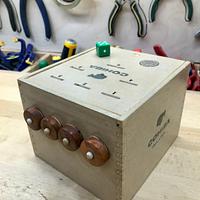
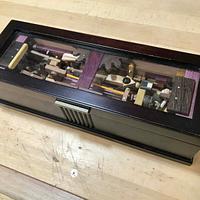
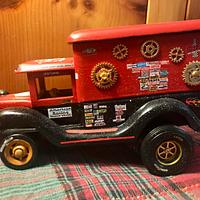
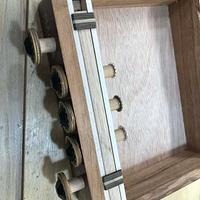
Just been catching up on what I have been doing. This combination lock is a fun addition to fun secret projects.
I started a Skool page and working to create a community that likes to build these kinds of maniacal mechanical locking systems. I have also been teaching folks that can make it to my isolated island workshop. It has been rewarding seeing different kinds of artist's find themselves excited for how they adapt their new skills.
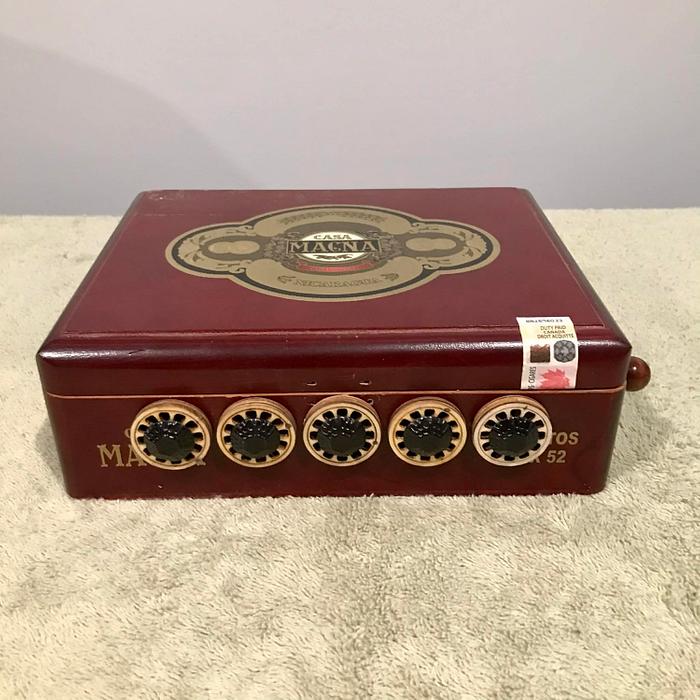
Cigar boxes are often a great resource for hacking away at something new with little invested in time and money. These kinds of cigar boxes are rare to find now as all new cigar boxes where are all cigar companies are now uniformly a bland shade of green with no artwork being allowed. This particular brand has side thickness of 1/2", sweet.
Here is a simple combination lock system where the 5 dials fully rotate and have variable settings which add complexity. The dials can be pushed in, pulled out, or anywhere in between.
Since this was a Skool project I was looking to create a fun dial that was quick and easy to produce. I had some of these laser-cut parts (dollar store) that I glued to 3 layers thick then gluing the extra large furniture tack (amazon). It was easy enough to glue it into the dowel shaft running through the box.
I definitely cheated with this shortcut. All it needed was to be a backing plate that would keep the lock shaft from being pulled out. An interesting side note: If you make the end plate secured with a fine screw instead of a permanent solution, ...you create a lock that is reprogrammable in that you can juggle the orientation of the dial shafts.
It might be surprising, but I try to use a tape measure as little as possible.
To mark the inside slider I rubbed some lead on the end of a dowel, pushed it up against the internal slider piece when it was pushed out to the edge, twisted and rotated the dowel with the lead on it to leave its mark.
In a fun and challenging way, when making the interlocking lid lock tabs, it can be like learning to cut crown moulding on your chop saw, that mental inversion for understanding. Working from the center line marked on both the lid and bottom keep the needed space and position for each piece. The large chunky piece gets glued into the lid at the same depth/thickness. It is wider than the other notched piece because the narrower notched piece will be set in further on the slider part. The length or depth of the notch equals the travel in the internal slider part. Easy breazy.
What I love about wood glue is that you have a few minutes to make sure that your parts fit right before you commit. What I do is I have the proposed location marked out, and I use just a drop of glue, enough to hold it still to test for fit and function. If all goes well, the parts interconnect perfectly, but if there is a hiccup and a part needs a little sanding or whatever, the glue bond breaks easily. This is also the perfect spot to see how much lid play there is when in the locked position. Ideally, you want very little movement, like maybe a 1/64th is good.
Anyways, thanks for looking, and if you get to hankering on wanting to make one, give it a go, or come join me on Skool. $25 a month will change your life. A fun community with other wack-a-doo's that like this kind of stuff, lol
Hey Guys, thank you, they are fun and while not easy, they are not that difficult. If you can tinker, this is for you, lol. Often I seek up on the right size/fit of parts AND I don’t glue in until the parts work as a dry fit. Thanks for looking.
It’s not so difficult, and if you like to tinker, this is the easiest way to learn. I have two students wrapping up their designs at the moment, both older like me.