








Share your craft projects
Make new craft buddies
Ask craft questions
Blog your craft journey

Fotodog
187 posts
and
10 followers
in over 2 years
in over 2 years
More from Fotodog
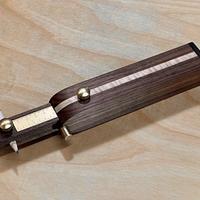
Mortising Jig
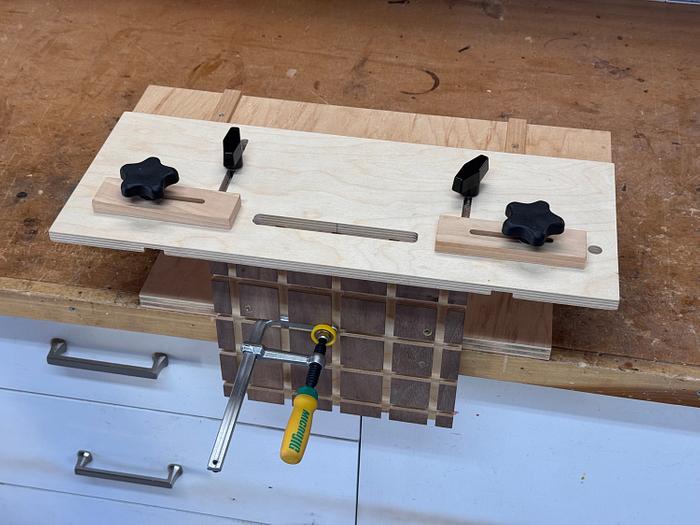
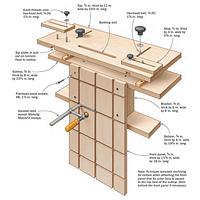
Greetings All,
I used slip tenon joinery for my last furniture project and thought that this technique has some advantages over dowels, which I have been using for a while. Even using a Dowelmax, which is a very well made product, and being as precise as possible, I would still have some slight misalignment of pieces sometimes. Maybe 1/32”, just enough to be problematic, particularly when working with plywood which may not be able to be sanded flush. And the problem with dowels is that there is no room for tweaking to achieve a perfect fit. Once the holes are drilled, that’s it.
I achieved nice results with slip tenons on my last project using a router with a spiral bit in my Moxon vise and an edge guide and stop blocks, but the setup was a bit tedious and not easy to duplicate once broken down. I had to be very careful to make sure that the edge guide was set perfectly square to the work piece. After some research, I decided to make a jig based on the design by Philip Morley, who has an instructional YouTube video and an article in Fine Woodworking: https://youtu.be/eHIOTXABu60?si=EYu0a0QY4rMx1R1v
The basic concept is using a 5/8” bushing in a matching slot on a sled which rides perfectly square to the slot. The 5/8” bushing allows for 1/4, 3/8, or 1/2” mortises which should be sufficient for every project that I will build. The system is based on marking center lines on your work pieces, which align to center lines on the jig. Stop blocks limit the router travel to define the length of the mortise. The tenons are made by milling stock to length and width, and then rounding the edges with the appropriate round over bit at the router table. The stock is held in place with Microjig dovetail clamps after a grid pattern has been made in the face board. I was on the fence for a long time about buying into this system, but it is fantastic.
This jig is quick to set up, easy to return to previous settings, and most importantly very accurate. I made mine slightly smaller than Morley’s design to conserve valuable wall space in my garage shop. I also made the top from 1/2” plywood instead of 3/4” to make sure that I can make mortises as deep as I like. I highly recommend this jig.
I used slip tenon joinery for my last furniture project and thought that this technique has some advantages over dowels, which I have been using for a while. Even using a Dowelmax, which is a very well made product, and being as precise as possible, I would still have some slight misalignment of pieces sometimes. Maybe 1/32”, just enough to be problematic, particularly when working with plywood which may not be able to be sanded flush. And the problem with dowels is that there is no room for tweaking to achieve a perfect fit. Once the holes are drilled, that’s it.
I achieved nice results with slip tenons on my last project using a router with a spiral bit in my Moxon vise and an edge guide and stop blocks, but the setup was a bit tedious and not easy to duplicate once broken down. I had to be very careful to make sure that the edge guide was set perfectly square to the work piece. After some research, I decided to make a jig based on the design by Philip Morley, who has an instructional YouTube video and an article in Fine Woodworking: https://youtu.be/eHIOTXABu60?si=EYu0a0QY4rMx1R1v
The basic concept is using a 5/8” bushing in a matching slot on a sled which rides perfectly square to the slot. The 5/8” bushing allows for 1/4, 3/8, or 1/2” mortises which should be sufficient for every project that I will build. The system is based on marking center lines on your work pieces, which align to center lines on the jig. Stop blocks limit the router travel to define the length of the mortise. The tenons are made by milling stock to length and width, and then rounding the edges with the appropriate round over bit at the router table. The stock is held in place with Microjig dovetail clamps after a grid pattern has been made in the face board. I was on the fence for a long time about buying into this system, but it is fantastic.
This jig is quick to set up, easy to return to previous settings, and most importantly very accurate. I made mine slightly smaller than Morley’s design to conserve valuable wall space in my garage shop. I also made the top from 1/2” plywood instead of 3/4” to make sure that I can make mortises as deep as I like. I highly recommend this jig.
11 Comments

ok Dog tell me what this this will do that my festool domino wont do ? now for the guy that cant afford a domino, and thats 95% of most hobby guys ! sounds like this is a winner for the guy with a tight budget ?
working with my hands is a joy,it gives me a sense of fulfillment,somthing so many seek and so few find.-SAM MALOOF.
Pottz, you’re right, I meant to mention that in my post but forgot. I think the only thing you might be able to do that you can’t with your Domino is make different sized mortises such as 1/4” for smaller projects.
hey that jig is cool though for those that cant swing a domino ! hell i bought mine on ebay several years ago for a discounted price, and discounted prices arnt that discounted ! 😬 nice post buddy !
working with my hands is a joy,it gives me a sense of fulfillment,somthing so many seek and so few find.-SAM MALOOF.
Thanks Pottz. I can afford a Domino but have been resistant in buying another specialty tool. It took me years to finally pull the plug on the Microjig Matchfit system 🤪
There IS a specific use that I thought about before deciding to build this jig, and that is making hidden spline joints which are typically 1/4”. I have come to prefer the clean look of miter joints for boxes with continuous flowing grain and no visible splines even over hand cut dovetails, but of course it’s a weak joint that needs reinforcing. I made a jig for the router table, but I think this will be better. All that’s needed is a 45 degree shim when clamping the work piece. It will also work well for picture frames when you want a clean look.
There IS a specific use that I thought about before deciding to build this jig, and that is making hidden spline joints which are typically 1/4”. I have come to prefer the clean look of miter joints for boxes with continuous flowing grain and no visible splines even over hand cut dovetails, but of course it’s a weak joint that needs reinforcing. I made a jig for the router table, but I think this will be better. All that’s needed is a 45 degree shim when clamping the work piece. It will also work well for picture frames when you want a clean look.
nice post my friend !
working with my hands is a joy,it gives me a sense of fulfillment,somthing so many seek and so few find.-SAM MALOOF.

Nice jig..the Matchfit system is very nice for some things.
You are correct about Festool Domino. There are likely a lot of us who can afford one but decide to do it another way.
You are correct about Festool Domino. There are likely a lot of us who can afford one but decide to do it another way.

I've always been fascinated by how clever these jigs can get. Before I built my router table, I made several simpler purpose built versions but nothing with any flexibility like this.
Nice shop project Foto!
Nice shop project Foto!
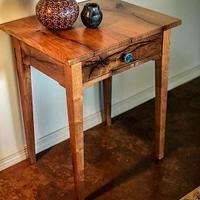
The Morley Mortiser. I built one a few years ago from his plans and posted it on another site. It was the best design I found for doing loose tenons accurately with a router.
Buying the Domino relegated it to mothballs though, and I wound up selling it.
Buying the Domino relegated it to mothballs though, and I wound up selling it.
Half of what we read or hear about finishing is right. We just don’t know which half! — Bob Flexner

Nice jig! I'll have to consider this for future work.
The Other Steven

Nice handy jig!!!
Next will be a mating tenon jig ????
Next will be a mating tenon jig ????
Cheers, Jim ........................ Variety is the spice of life...............Learn something new every day
I plan on sticking with loose tenons, so I don’t think I’ll be making a tenoning jig. The loose tenons are easy to make by milling the stock to length and width, and then rounding over the edges at the router table. I’ll probably settle on 3 or 4 lengths and widths for most of my projects, so I’ll make extra tenon stock to have on hand.
For those that haven’t seen Philip’s video, he shows a great method for quick setup and repeatability to match a previously made mortise. He makes setup blocks for the length of the mortise that accounts for the diameter of the router bit. For instance: For a 2” mortise using a 3/8” bit, subtract the bit diameter from the mortise length to determine the amount of travel needed, which is 1 5/8”. Now add the width of your router base, in my case 5 3/4” for my Dewalt trim router, which results in 7 3/8”. Make a shim this length and mark a center line. Place it on the mortising jig aligned to the center line there, snug up the 2 stop blocks on each end, and Bob’s your uncle. You now have a setup block that allows you to repeat the setup for this mortise in the future in seconds. It probably sounds more complicated than it is.
For those that haven’t seen Philip’s video, he shows a great method for quick setup and repeatability to match a previously made mortise. He makes setup blocks for the length of the mortise that accounts for the diameter of the router bit. For instance: For a 2” mortise using a 3/8” bit, subtract the bit diameter from the mortise length to determine the amount of travel needed, which is 1 5/8”. Now add the width of your router base, in my case 5 3/4” for my Dewalt trim router, which results in 7 3/8”. Make a shim this length and mark a center line. Place it on the mortising jig aligned to the center line there, snug up the 2 stop blocks on each end, and Bob’s your uncle. You now have a setup block that allows you to repeat the setup for this mortise in the future in seconds. It probably sounds more complicated than it is.
More from Fotodog
