





Share your craft projects
Make new craft buddies
Ask craft questions
Blog your craft journey

Fotodog
187 posts
and
10 followers
in over 2 years
in over 2 years
More from Fotodog
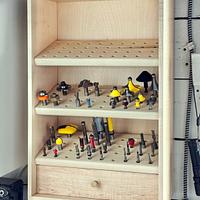
The Grand High Exalted Wooden Waste Repository
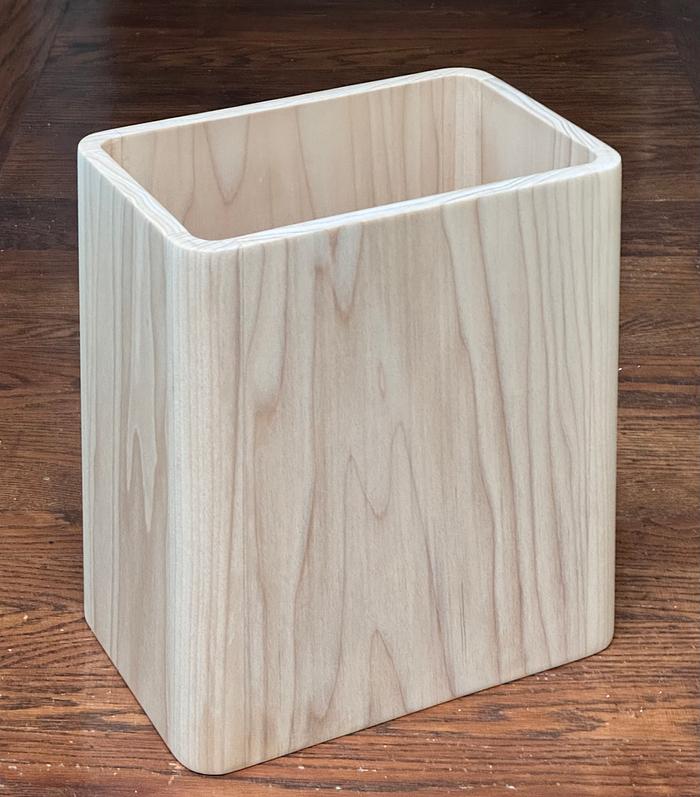
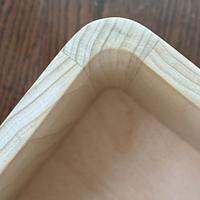
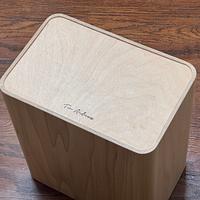
Okay, it’s a trash can. It just sounded better the other way. My wife requested said item so of course I made one. I had originally planned on using figured maple, but I found a piece of poplar that I liked with nice grain and without the green tints that are common.
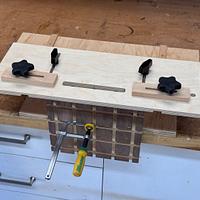
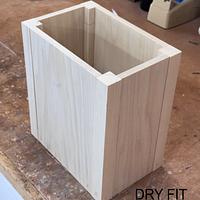
I chose 8/4 stock because of my design which called for 1/2” thick panels attached to oversized posts in each corner, which could then be rounded over. I was fortunate to find a 13” wide board so there was enough width for the panel and both posts to create continuous grain wrap where possible. After milling the stock to size, I cut mortises with my newly built mortising jig, milled up some loose tenons, and did a dry fit to confirm my measurements. The posts were left 1/16” proud to allow flush trimming after glue up.
After disassembling everything I knocked off the inside corners of the posts at 45 degrees and followed up with a 1/2” diameter cove bit at the router table to establish the inside radius. I then did my glue up and rounded over the outside corners with a 1” round over bit.
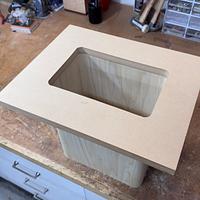
The bottom proved to be an interesting problem. I wanted a tight fit, because who doesn’t want a nice tight bottom? My approach was to rough cut a hole in a piece of 1/2” MDF slightly smaller than the opening on the bottom of the can, and then using a flush trim bit to make it the exact size as the opening. I then routed a 1/2” rabbet around the perimeter of the template, followed by flush trimming off the excess. This created an opening 1/2” wider than the inside of the can on all sides. I then taped this template to a 1/4” piece of maple plywood and used a 1/4 flush trim bit around the perimeter to create a bottom that was exactly 1/4” larger than the inside of the can. Final step was to cut a 1/4” rabbet in the bottom of the can, and Voila, by some miracle it fit.
For the finish I applied a coat of Osmo natural followed by 2 coats of Osmo 3043 satin. I like starting with the natural in woods where I don’t want much additional warmth. Thanks for looking.
17 Comments

That's pretty neat! I want one. I'd radius the opening, though. I'm a clumsy old man who breaks fingernails more on square edges.
The Other Steven

what size are we talking about here since it's a "trash" can !
working with my hands is a joy,it gives me a sense of fulfillment,somthing so many seek and so few find.-SAM MALOOF.


That's neat Dog... SWMBO must be appeased or it's the real house 4U.

Never thought of wooden. I use a wire-mesh one

so I can see when it's full and not to try to put any more trash into it.
Some members advocate "we're not here to teach"... well I have learnt something... not how to make wooden trash bins, but a neat way to do inside radii in boxes... may be obvious to most, but new to me, before I need inspiration from a cask-o-vino!... though a few more imbeded pictures would have saved me some reading.
If your first cut is too short... Take the second cut from the longer end... LBD
Thanks gents. The size is 7” x 10.5” x 11 3/4”. It’s not too big since it’s for the bedroom, and was sized so that the metal can that it replaced can be placed inside if the boss thinks that’s necessary. Duckster, I had to learn about the relationship between inside and outside curves myself. As it turns out the formula is very simple: outside curve diameter minus stock thickness equals inside curve diameter. In my case, 1” outside diameter minus 1/2” side thickness equals 1/2” inside diameter. It seems obvious once you know but I was expecting something more complicated.
It's not the maths that got me... I never thought of using corner blocks and routing the "inside" radius before glue up.
7” x 10.5” x 11 3/4”
You'll need more than weekly garbage pickup to clear that small container.
If your first cut is too short... Take the second cut from the longer end... LBD
Great idea and nicely executed. I need to somehow fit a trash bin into my little shop. God know where though. LOL.
Andy -- Old Chinese proverb say: If you think something can't be done, don't interrupt man who is doing it.

For a trash can it is attractive looks good.
Ron
Nicely done.
Ryan/// ~sigh~ I blew up another bowl. Moke told me "I made the inside bigger than the outside".

This has been on my bucket list forever!
I want to make something with fancy sides and for once something that'll fit the small can liners with a top to cinch up the bag to the sides.
I'm impressed the way you did those corners and used solid, full width stock! Bonus for sizing to act as a decorative outer shell for a boring plastic pail.
Well done!
I want to make something with fancy sides and for once something that'll fit the small can liners with a top to cinch up the bag to the sides.
I'm impressed the way you did those corners and used solid, full width stock! Bonus for sizing to act as a decorative outer shell for a boring plastic pail.
Well done!
You're right on the tight bottom.
The inside/outside radius is perfect!
Pretty cool project.
The inside/outside radius is perfect!
Pretty cool project.
Petey

Neat waste basket!!!!!!!!!!!
Cheers, Jim ........................ Variety is the spice of life...............Learn something new every day

Nice job - the rounded corners are a nice detail.

I dont see the foot pedal mech
Regards Rob
Real nice bin!!!!!!!! Nice job of blending in the corners with solid stock like the panels!!!!!!!! Are there biscuits or dowels in it to register all pieces in dry fit to insure alignment when bluing?
Cheers, Jim ........................ Variety is the spice of life...............Learn something new every day

Well done, so was the Missus happy with the final?
Yes, the Missus was happy, I got an extra large slice of cake that night 😁
More from Fotodog
