



Share your craft projects
Make new craft buddies
Ask craft questions
Blog your craft journey
Mike_190930
57 posts
and
5 followers
in over 3 years
in over 3 years
More from Mike_190930
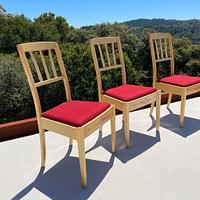

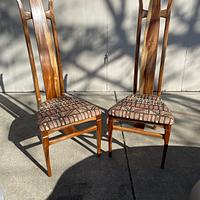
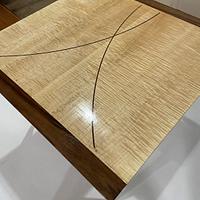
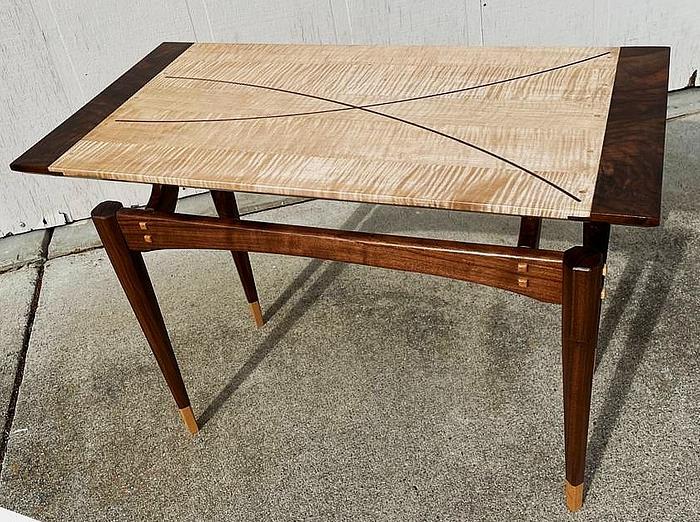
Side Table in Walnut and Curly Maple
Getting the Lumber
A couple of years back I built a corner table in walnut and maple, described here, to fit in the space between two couches set at right angle to one another. Due to a lack of suitable timber, I did not build a matching table for the other end of the couch, something I heard about from SWMBO roughly every 4.7 days. With loving diligence, though, I had been for a few years keeping my eye out for another matching board of figured maple, without any luck. But patience pays off. While walking through one of the big box stores recently, looking for some plywood, I chanced to spy a maple board lurking behind several others in the hardwood lumber section – and it seemed to have the figure I was looking for. After shuffling about fifteen other boards out of the way, I got my hands on the prize – ten feet of 6” wide figured maple. What was a wonderfully figured board like this doing hanging out in a seedy big box store lumber pile? I rescued it.
Making Sawdust (Build blog can be found here)
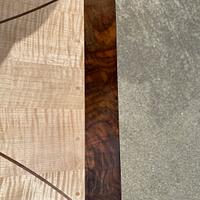
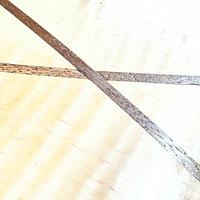
For the top, I used the same construction as the corner table, scaled down to be 14” wide and 28” long. As before, I made breadboard style ends from walnut, with the tongue and groove reversed from the traditional placement to allow using maple dowels on the maple side of the joint. The walnut came from a slab I had bought years before because it had some wonderful crotch figure. The top inlay is cut on the CNC router with a 1/8" bit. The inlay strip of walnut is thinned on the drum sander to 1/8”.
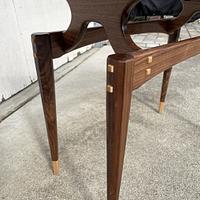
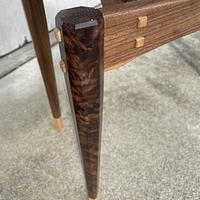
The leg blanks are cut from the same walnut 8/4 crotch slab, glued with mortise and tenon to the maple cat feet, and tapered on the table saw. Finally, I used a 45 degree bit on the router table to arrive at the octagonal cross section tapering to the narrow square cross section at the bottom. The curved rails are cut on the band saw, smoothed with a spoke shave and sanded smooth by hand. For the frame, the cross members and legs are attached with maple floating double tenons in thru mortices; the square "buttons" are actually the tenon ends.
Finish is two coats of hand rubbed shellac and five coats of wipe on Minwax satin Tung oil varnish.
Huh? Whadaya mean it ain't "measure once cut twice"?
19 Comments

This table is astounding. I can not take my eyes off the eye popping top.. The wood is beautiful and finishing technique makes it pop. But, one can not ignore the grain of the legs. Overall, one of the best projects I have seen.
Very unique table, I love the choice of woods!!!
Cheers, Jim ........................ Variety is the spice of life...............Learn something new every day

Wonderful wood. Great assembly and design. Overall a really good looking table, well done!
Ron
Very distinctive. Great design and execution. Love the lumber choices. Nice work....
That’s just stunning! Beautiful wood too. Very nicely done!
Ryan/// ~sigh~ I blew up another bowl. Moke told me "I made the inside bigger than the outside".

I've read of others terrible misfortune to be at the BORG, and spy a piece of wood so polluted with stripes it hardly looks able to hold itself together. No matter how many times I go there I have yet to see anything with even a squiggle of that offending grain. Maybe I need to go more often.
Cheers to your good luck, and my my, what you have done with it looks amazing. Nice job.
Cheers to your good luck, and my my, what you have done with it looks amazing. Nice job.

Gorgeous!
The hidden "junk wood" as George so elegantly describes is a long running quest at the BB stores, they often have spectacular maple (tiger and ambrosia) mixed in the usual bland stuff. Seems best time is when they get a fresh restocking, word is out!
That wood you used is exceptional, both the walnut and maple! The shape of of the top lifts is really nice, great layout of every inch.
Fine work Mike!
The hidden "junk wood" as George so elegantly describes is a long running quest at the BB stores, they often have spectacular maple (tiger and ambrosia) mixed in the usual bland stuff. Seems best time is when they get a fresh restocking, word is out!
That wood you used is exceptional, both the walnut and maple! The shape of of the top lifts is really nice, great layout of every inch.
Fine work Mike!

i agree with all said that wood is stunning. i really love how you did the legs and joinery, just a really beautiful design. also what was your technique doing the inlay on top ?
working with my hands is a joy,it gives me a sense of fulfillment,somthing so many seek and so few find.-SAM MALOOF.

You hit this one perfectly! There are so many details done to perfection. Well worth the wait!
Thank you all for your kind comments. I posted a build blog if you are interested in the details. Thanks again.
Huh? Whadaya mean it ain't "measure once cut twice"?
Worth waiting for—beautiful timbers.

Beautiful, no, very beautiful.!
That’s a gorgeous table. Maple with walnut is one of my favorite wood combinations, and you found particularly good pieces of both. I can’t believe you found that maple at a big box store.
Your workmanship is impeccable, from the joinery to the finish.
Your workmanship is impeccable, from the joinery to the finish.

Beautiful table, nice attention to details.
Good on you mate.
Madts.
Madts.
Tor and Odin are the greatest of gods.

What a great looking table. I love the floating top.
Beautifully done!

Mike,
The table is a beauty!! Love the wood choices, both the walnut and especially the curly maple. The finish is superb. Bread board ends, though tenons, cat foot leg ends it all adds to a win. Good job.
I found a piece of curly maple at a wood store in Arizona, 4/4 x 8 x 50ish. Did not have a project in mind but could not pass it up.
The table is a beauty!! Love the wood choices, both the walnut and especially the curly maple. The finish is superb. Bread board ends, though tenons, cat foot leg ends it all adds to a win. Good job.
I found a piece of curly maple at a wood store in Arizona, 4/4 x 8 x 50ish. Did not have a project in mind but could not pass it up.
daveg, SW Washington & AZ
Excellent work and design!
Petey
More from Mike_190930
