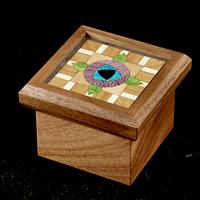
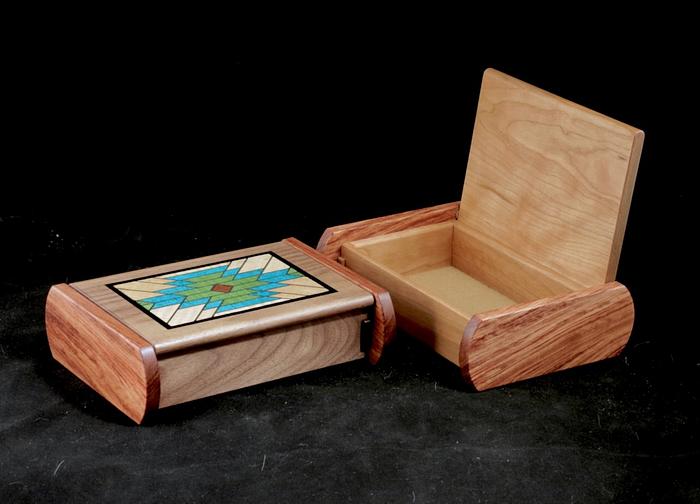
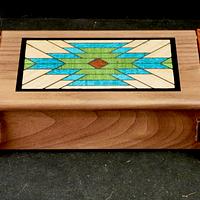
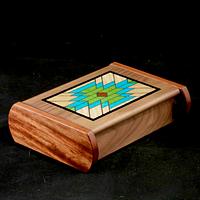
Another experiment with veneer parquetry of course.
I wanted to try some more A&C designs that look a bit "Southwestern", but I wanted to try a different way to display the panel without making a traditional frame around it.
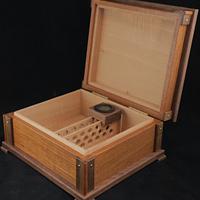
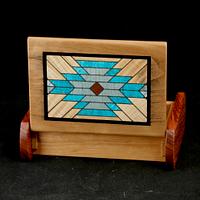
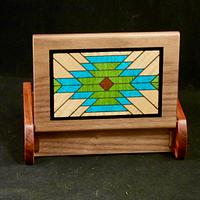
These boxes are about 7" x 5" x 2", one is walnut based and the other is cherry. The end caps are rift sawn Bubinga which I bought in a moment of insanity/weakness from Cook's Woods. It does have phenominal chatoyance and color shift depending on the viewing angle.
The Panels.
I've shown these made before, just some laser cut dyed veneer (Kote) and curly maple for the whiteish areas.
Put back under the laser after glue up to fatten and square up the gap between the pieces.
After glue up:
Post fattening:
A few steps up to the last photo.
I wanted to have the veneered surface flush with the frame, which would be a solid form with a cut out center.
To get the frame, I resawed a thicker piece of wood and made a frame slice about 1/4" thick. The center was cut out with the laser. Photo above shows this cutout piece with the panel sitting inside.
I used my drum sander to get both the frame and backer as flat as possible (even thickness all around). I then re-glued the two halves back together preserving the grain flow so it still looked like one piece from the side. This could also be done with a template and router mortising bit but no way to get the sharp corners. Either way, this was fast and easy.
The cherry on the right shows the two pieces rejoined and the walnut on th left has the panel resting inside.
Next was to laser in the lines on the panel and fill with black TimberMate. I used a goodly amount of AquaCoat on the veneer surface to keep the TimbrMate out of the veneer pores, applied before lasering.
WIth the fill done, I glued the panel into the recess with a caul to ensure it was flat. Next step was to sand down the frame to flush with the veneer. Since the veneer is only 0.022" thick, this had to be perfect. I measured the veneer surface height over its perimeter on my granite surface plate with a depth indicator. Back through the drum sander with a layer of tape (0.004") in the thin spots to raise it up even.
Eventually I got it to where I could lay in the black border (acrylic resin with black TransTint). An old credit card was used to grout in the TimberMate and syringe to fill the resin.
I used shellac around the outer edge of the panel and inside edge of the frame to control bleeding of the colored fill.
I didn't want to flood the surface with the resin as that would mean more sanding of the thin veneer, so I went slowly. The resin had an open time of several hours so I waited until it was getting viscous, filling took advantage of the surface tension to bulge up on the edges such that the resin was higher than the veneer surface.
All in all, a real pain! The 5th gallery photo shows how the cherry absorbed some of the black dye (capillary action) and the veneer sucked some of the dye from the TimberMate. I can probably use more shellac as sealer or wait for the resin to get stiffer before applying, but the TimberMates location won't allow for that sealing on the veneer edges.
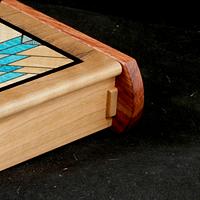
The rest of the box is basic. A side panel template with hinge pin location hole was lasered. The aluminum template is for drilling the pin hole into the sides of the lids.
This Bubunga has matching resawn halves for each box.
The interior tray is cut to fit, Box joint to help with keeping the box together. The shorter side pieces are glued directly to the Bubinga, front/back have a 1/16" brass pin to lock the finger joint together.
Bottom is rabbeted on the front/back and lapped over the sides for a felt covered 1/8" thick bottom of matching wood. This further locks the box sides together and makes the felt lock under the interior so it will never peel up.
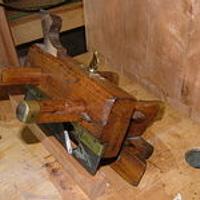
I did trim the felt slightly so the bottom would get some wood on wood contact for the glue. Trimming was easy with the blade on my mortising gauge.
With the lid overhang in the rear, I could slide the box tray forward/back until I got the 95 degree lid swing.
The resin had an open time of several hours so I waited until it was getting viscous, filling took advantage of the surface tension to bulge up on the edges such that the resin was higher than the veneer surface.
All in all, a real pain!
FYI, alcohol (as in TransTint dyes, or add a little ethanol from your shellac ingredients) will lower the surface tension of most epoxy resins. A year and change ago, I did some experimenting while making one of my resin and cholla lamps, and I couldn’t quite get zero meniscus on the resin, but I could get it a lot lower by adding just a few drops of alcohol.
Never thought I’d have a good reason to use that, but it sounds like this might be a case where that would’ve been handy to know.
Beautiful little boxes, Splint! Nice work, as usual.
Duck, is there anyway to motorize my mortise gauge?
BB, I have a general idea (slab sides), but with these experiment panels I start there and let that determine the dimensions. Also helps looking at the cutoffs littering my TS extension and knowing that it's either put that stuff somewhere or cut it up into smaller pieces for a box.
Dave, Usually I like the lower viscosity for making sure I get resin into all the crannies, but some woods like the cherry (last gallery photo) shows how it likes to drink it up. The resin claims a "working time" of 45 minutes at 70F and about 100 minutes at the shop temp (63F), but I should have waited a few more hours until it was almost ready to gel. Certainly some better sealing of the end grain next time too.
Yeah, Splint. When I intentionally make epoxy runny, I either make sure I have wood with closed pores or use a quick splash of shellac to seal the end grain if I don’t want it penetrating.
Wondering if the cut of the wood itself, flat sawn, versus rift or QS as to how thirsty the wood is when adding fluids for any purpose would make it? Might be able to control it better. Of course this is more testing, and somewhere along there I imagine, let's just get this done, enters your mind.