A commission from a ‘miner’ who had worked all over the world. He had visited the gallery where I sell bits and pieces of my work, but that particular day I had taken my ‘Ancient and Modern Table cabinet’ a complex cabinet, to demonstrate it at an open day! If you’ve never seen it, here’s the link.
We never got the chance to speak on the day, but having seen the cabinet and its intricacies he contacted me to ask if I would be interested in making a ‘box’ for his daughter’s birthday. Yes, was my answer, so he came over to see more of my work and discuss a design. Amongst other boxes I showed him was my wife’s ‘Klimt on a Box’ – check it out here.
He particularly liked the concept of its fold-out wings - so, we had a starting point. However, the box for his daughter went on hold, and we entered discussion about a ‘Miners box’ for him to keep the bits and pieces from his extensive career working in different mines around the world.
The fold out wings design of ‘Klimt on a Box’ is based on the work of George Betjemann & Sons, who made very high-class Victorian boxes for the UK’s aristocracy. They patented a mechanism hidden in the sides of the box which opened out the wings as the lid was raised.
Their work was on display at the London International Exhibition of 1862, and the International Exposition of 1867 in Paris. Alas I never got to include the mechanism in my wife’s box!!!
If this sort of classic box rocks your boat, checkout this George Betjemann & Sons link here: and a whole load of other exquisite Victorian boxes on Daniel Luciens amazing site here:
So, we had a starting point, with the idea of adapting the concept to include more drawers, 12 in all – one for each of the mine sites/companies he had worked at. We decided on 6 drawers in the back of the main structure, and 3 in each of the fold out wings. We went for one wing each side rather than 2 as was usual in Betjemann’s design.
This was my starting point.
- a sort of cross-section view of the open box. It would have a lift up lid, a drop down front, and a fold-out wing each side. The blue are open trays, the green is the two secret drawers in the base, and the brown the two lift out boxes housed in the top trays.
OK…….. complex but doable and the sort of challenge I usually like!! Book matched burl veneer framed by jarrah with edge bandings and strings to finish it off.
The back top and front with their book matched maple burl and Jarrah surround.
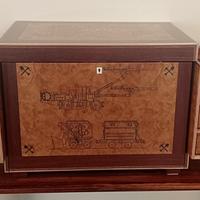
But the commission then grew, and grew, and grew ……. as the client became familiar with the design, and its range of flat panels. He started adding surface decoration to the flat panels. Engraved line drawings of mining equipment on the front and lid, and a tunnel drilling blasting pattern on the back.
It would have marquetry pictures of an old shaft mine, and a modern opencast pit on the front of the wings. On the inner surfaces of the wings it would have St Barbara, the patron saint of miners, on one, and a cloth badge inlayed into the other wings.
But there was more! It would have a leather skiver on the drop down front, and a large cloth badge – the West Australian School of Mines, on the inside of the lid!! Each drawer was to have an inscription of one of the mines names, together with the flags of their countries, and samples of what they produced!
This was going to be some project!! As the size and complexity grew, I started to call it a chest rather than a box!! Its dimensions are: 450mm /18inches wide X 240mm / 13.5inches front to back X 330mm / 13inches high
With the panel panels veneered it was time to start on the engraved designs that would go on them. Working on the designs the client wanted on the lid, back and front I traced them in MSWord to get digital images, that Len, my Laser engraving friend could manipulate into a drawing for his laser.
The design for the top panel
The drop down front
The rear panel
But first I needed the outer panels prepared for the laser. I finished their surfaces with around 6 or 7 coats of oil based polyurethane, sanded them down between coats and once the grain was filled, I sanded them down to 2000 grit - but no wax polish. The super fine smooth finish would mean when I loaded the engraved designs with paint, I could sand the paint back without worrying about the dust contaminating the veneer, or any scratches from coarser grit sand papers. I probably put three of four lots of paint over the engraving as I sanded them back to ensure I got rid of any ‘holes’ that were left in the engraved lines. These were then left for 3 or 4 weeks while I continued with other parts of the chest. My experience is that the paint in the engravings and a poly finish will shrink overtime into the grain and the engraving destroying the flat polished surface. So, after time I was able to apply more poly and repeat the sanding to get the flat surface back.
I polyurethaned the lid panel, back, sides and front in this way, though the sides or wings, were going to be left as plain veneer. The first panel we engraved was the back, with its drill hole pattern. The black lines showed the angle of drill and the circles, filled with Pau shell or mother of pearl dots, where the charge would go.
The finished back.
With the back panel completed I could at last start to put the main frame of the chest together. Splined mitred joints on the rear corners, mortice and tenons on the front and the base in a rebate
The main box frame with its jarrah edging and fitted wings. Held together with clamps as this stage.
My usual method of box construction is to make a veneered plywood sealed box and then saw it in two. That way the lid is bound to fit. But with a drop down front and wings this wasn’t going to be possible. To keep the sides of the box neat and uncluttered with the usual hinge knuckles, I decide to use barrel/Soss hinges as I had done on ‘Klimt on a box’. Those of you who have used them will know what a pain they are as you need a set of holes that line up very accurately on the ‘door’ and the ‘door frame’! I get around this by drilling holes in one piece of wood for the door and the frame then sawing it in half. The strips with the holes in are then glued to the door and door frame so the holes are bound to line up. Hmm!
With the wings open and barrel hinges visible – still prior to gluing up.
Next came the internal framework for the drawers, which fitted into housing in the main ‘box. At this point the whole internal framework and outer box could be glued together.
Then came the two wing box frames which would be screwed to the wings once finished. To save weight on the barrel hinges I used two framed drawer runners rather than a complete shelves.
I decided to make the lid frame from solid Jarrah. This would enable me to plane it to fit the base without the worry of planning through any veneer – but that would be one of the last things!
With the main engraving done for the outside, it was now time to look at the marquetry pictures that would go on the front of the fold out wings, and the St Barbara image he wanted on one of the inner sides.
The images supplied by the client.
I simplified his original pictures to make them easier to cut at the sizes required. The three pictures were then cut mainly with a fret saw plus some use of a scalpel and a pyrography pen.
The back of the old mine shaft scene, before letting in some detail
………….. and the finished panel.
The open cast scene………………………………..
The wings with their marquetry panels.
St Barbara
Original picture Simplified Finished
St Barbara in place on the right wing, and the recess for the badge on the left wing. The drawer fronts had the same book matched maple burl as the outer surfaces. Here the drawers are in place but without the cock-bead.
The bottom tray is in place which hides the two ‘secret’ drawers hidden under the six rear drawers
The drawers had to be set back as when the wings are closed as any knobs would have been in the way. I was going to use magnets on the backs of the wing drawers, and a slider with more magnets on, which when pulled up would have repelled those on the drawer backs and forced the drawers open. You can just see the hole in the back of the wing trays where the slider would have been raised, but I decided the weight of the drawers even before anything was put in them would be too much for magnetic forces!!
The fall front with its leather skiver. You can see the cock beads around the wing drawers, and the pigskin suede lining in the bottom tray.
OK probably enough about the construction … Lets look at the finished chest in detail
The small feet are there so that there is room for the fall front to go down.
The lime wood edging and banding
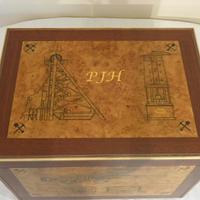
The top panel – I even put his initials, just visible, on the Davey lamp!
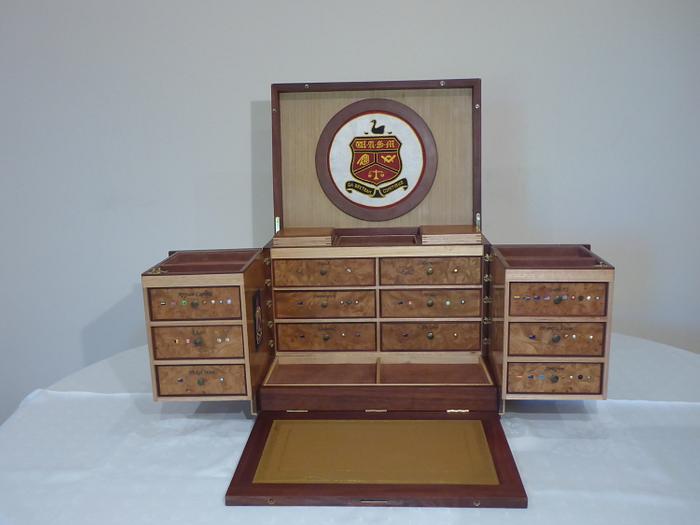
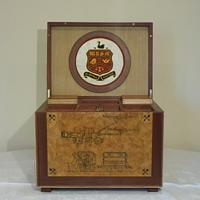
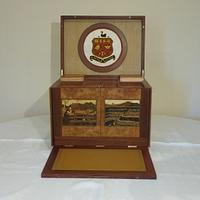
With the lid raised you get the first view of the interior. You can just see the alignment pegs in near front corners of the lid which helped to hold everything together, and the pair of Andrew Crawford's smartbox hinges. The large cloth badge was set into a recess in the lid and surrounded with a jarrah veneered frame.
A better view of the top trays and the two small book-matched treasure boxes. The wings are held in the closed position by the small catch at the middle front. The trays are lined with pig skin suede, as are all the drawers.
The front dropped to reveal the wings and their marquetry panels. I eventually removed the middle hinge on the fall front.
The wings on their way out. In the pieces of the sides below the wings, is a small steel pin which protrudes upwards. This matches a groove in the base of the wing box frame. As the wings open the protruding pin is out of the way in the groove, but as the wing opens to 90 degrees, the groove is 'stopped' by a small brass plate on the bottom edge of the wing which stops it opening any further.
The wings full open. They rest on half the thickness of the fixed bottom sides pieces. You can now see the cock beads around the drawers which disguises the fact that they are set back.
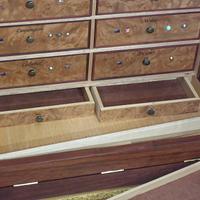
Some of the drawer fronts with their mine name, the flags of their companies countries - sourced from AliExpress, and the minerals they produced. Alas Ekati doesn't have real diamonds!!!
I haven’t said much about the ‘secret’ space and two 'secret' drawers - they aren’t now!!! They are in the bottom of the chest hidden under a lift out tray which can be removed when the wings are fully opened.
With the tray removed its supporting framework can be removed, helped by a spring in the rear right corner, which gives access to the two secret drawers.
The next to last piece of the chest was fitting one of Andrew Crawford's smartBoxmaker locks, to go with the lid hinges, together with an ivory escutcheon,. The ivory was sourced from an old piano key - thanks Barry.
And last ............. the final pieces were the two turn buttons which hold each wing in their open position. I came up with all sorts of ideas for this – the more usual mini door/surface bolts, a spring-loaded pin that would pop up when the wings were fully open, a stay on the rear top corner of each wing etc. etc. But these little jarrah turn buttons seemed the best!
So that’s it. A miners Chest.
A complex project which took eight months from commission to completion, and around 550 hours of work!!
Thanks as always for looking, and of course well done if you got this far!!
your work always blows my mind madburg ! way above anything i could even dream of creating. at 550 hours i dont even wanna think how much he paid you for this work of art.
working with my hands is a joy,it gives me a sense of fulfillment,somthing so many seek and so few find.-SAM MALOOF.
What an incredible and beautiful work of art. It is just stunning and you craftsmanship is unbelievable. This is simply breathtaking. Well done. . . .and those words do not even begin to describe the excellence and finesse you exhibit . Thank you so much for sharing.
I've been waiting until I could give this post a full read through. It is always a pleasure to see your creations! This one seems to have a lot more input from a client which makes for an interesting story.
Excellent project and write up! Thank you for taking the time to share your work with us.
Oh my word Martin! 550 hours of your previous time and what an incredible piece of craftsmanship. All the intricate work, the beautful marquetry and all the drawers. This should go to the international miners museum! I enjoyed reading about its evolution. What a talented uncle I have.