1.1 Our kitchen was about 12' x 12'. Add to the size limitations the fact it had a sliding glass door. So, there went a little over 6' of wall that could have been used for counter space and upper and lower cabinets. Add a stove, fridge and sink and the counter space and storage was nothing to write home about.
1.2 I'm a part time genius (snert), so I did the obvious, I converted our one bedroom house to a zero bedroom house. Something every realtor would applaud, right?
1.3 To be fair, the details of that choice included: I knocked out the non-load bearing wall separating the only finished bedroom in the house from the kitchen, to convert it to dine room open to the kitchen. And, there are two 15' x 24' rooms downstairs that just needed permanent closets to qualify them as bedrooms.
2.1 I removed the slider from the kitchen by matching the T-111 covering the remainder of the house exterior, and matching the interior sheetrock, giving us more than 6 feet of additional wall space for lacking counter space and upper and lower cabinets.
3.1 My wife wanted a window over her stove. I told her, "that's not normally done, because of grease and such, but it's our house outright and we can do any thing we want."
3.2 To the end of adding a window over the stove, I moved the stove from the interior wall to the exterior wall on the opposite side of the kitchen.
3.3 To move the stove, I ran a new copper line from the panel to the where the slider used to be, and moved the stove there (the old, aluminum line, even if re-routed, wouldn’t reach).
3.4 I placed the fridge directly opposite the stove. Before, it, somewhat, blocked smooth entry from the rest of the house to the kitchen.
3.5 Years in, a [small] window over the stove is not as problematic as many claim.
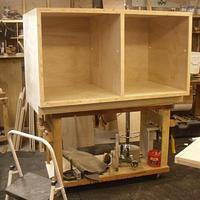
4.1 I built all the upper and lower cabinets using 3/4" ply for the boxes, poplar for the door frames, and beadboard for the door panels (wife wanted white, that is, a bigger kitchen).
4.2 There are no lower shelves. I’d watched my wife remove everything from a lower shelf, get what she needed, put everything else back, do her cooking, then reverse it all to put items away. Saints don’t have that kind of patients. I, certainly, do not. Subsequently, I made ALL the lower shelves into drawers with 100# slides.
4.3 Now, my wife made clear, were we to move, she'd insist the new place have the same kind of lower storage areas. Guess just pulling a drawers open, grabbing what she needs, pushing the door shut, doing her cooking and reversing the processes to put it away, all in a fraction of the time and frustration it took the old way, settled well with her.
5.1 On the matter of the fridge, a few years earlier, I'd remodeled a friend's entire kitchen. In the course of that, he bought one of those big, current era fridges to replace his still working 30 year old one, and asked me to made a cabinet covering the entire top. As he put it, you end up putting all kinds of things in front of those smaller cabinets anyway, so. . . .
5.2 My add to his suggestion of a large cabinet over his fridge was, a 30" lazy Susan. Because the cabinet was wider than it was deep and the Susan had to be made to the lesser depth, that left a side for storage of thins like cookie sheets.
5.3 My friend said he was more than sold on over-fridge cabinet and Susan, because he no longer had to dig for things, and the sheet storage was a big plus.
5.4 Since the full sized cabinet worked so well in the friend’s remodel, I did the same for over our old fridge, which died a year later. Requiring me to build a replacement, because the new fridges are much taller, and wider. The old cabinet, now, stores pillows downstairs.
5.5 Our version of an over-fridge cabinet has a side exposed to the entry to the kitchen. For that reason, I reinforced the build and added doors to that side. allowing access to the Susan from the front and misc. storage of things on the, roughly, 6" wide area on the side from the side.
6.1 Next was the matter of blind corners that, absent special attention, is where things get parked and lost forever.
6.2 For one of the lower corners, I went with the mandatory, standard, full sized lazy Susan.
6.3 To avoid wasted space between the Susan and the sink, I added a wall on the left side of the Susan for storage of cookie sheets and such. The other side has a single shelf and lends itself to cutting board storage.
6.4 My one regret is letting myself feel pressured to be done by people ignorant of the complexities of such work and failing to put as much effort into the upper blind corners as I did the bottoms.
PHOTO
7.1 For the opposite lower cabinet blind corner, I went with two “secret” drawers that are only accessible after a rolling cabinet is pulled out. Once the pull out is rolled out, they can be pulled out into the space where the roll out was.
7.2 They have tall sides that drop down near there the front and side meet to make accessing their contents easy.
7.3 Things used only a few times a year store well there.
8.1 The pull out, which, when removed, sits in under the counter top and where the hidden drawers pull into has a butcher block top. The top drawer is the silverware drawer, with permanent dividers for two different sets of silverware.
8.2 When I did that mentioned remodel [for a friend], I noted several drawers had been nailed back together over the years. To say the results were ugly would be an understatement. Think of someone using a ten penny nail to assemble small drawers.
8.3 Add to the foregoing, there were no organizers in the drawer. Everything got thrown in together, and they stirred things until what they wanted came to the surface of a hundred knives, forks, spoons. . . .
8.4 I built new drawers with special joints that, even if the glue failed, the fronts and backs would not pull off twenty years down the road. Also, I added dividers for regular knives, steak knives, teaspoons, tablespoons, salad forks and regular forks.
8.5 The owner must have liked the new drawers, because, when I came back, all the old silverware was gone and two new sets, organized in their respective slots, were in place.
PHOTO glens silverware
9.1 The bedroom made into a dine room open to the kitchen had a sliding door too. (This poor, tiny, house had five sliders. We’re down to three). I converted it to a more useful double French door (lucked out on sizes).
8.2 Had to raise the French door to be able to put a run down. Since the header was 0.0" above the door casing, that meant either trashing the casing or major saw work on the header. I choose the latter and the door opens and closes better than it ever did with the top part of the casing.
10.1 Because it’s a French door, a means of adding view blocking curtains was a must. This meant adding a curtain rod to support the curtains.
10.2 One thing leads to another, or 5. In this instance, the curtain rod interfered with the cabinet door of the mini-pantry. To get past that required a shorter door. However, that meant the upper, several inches of the cabinet were unusable, absent a non-standard solution.
10.3 In the course of trying to figure out what to do about the wasted space above the last shelf, the wife asked if I could do something with some of the powerful magnets I so often played with. The question became the answer/solution.
10.4 I made a small, removable panel with rare earth magnets embedded in it. Line up with them and in the cabinet were three opposite pole magnets. The magnets have a life span of about fifty years and hold the panel in place very well.
10.5 To make putting the panel back in place, I beveled edges of the back framework, essentially, making the panel self aligning, when lifted back in place.
11.1 Because this was such a major project, I’d opened much of the walls, to allow me to run plumbing and wiring, and to install horizontal framing connected to the vertical wall framing for mounting cabinets.
11.2 I took pictures of all the new and existing wiring and plumbing. A few years down the road, after experiencing kitchen sink clogs that were hard to clear (e.g., the original builder(s) put T’s where they shouldn’t have), I decided I needed to add a cleanout that was easier to access. Thanks to those photos, I was able to pinpoint the original drain line and vent, cut into the exterior T-111, install a sweeping drain, then close the add on with just the screw cap showing. I’ve used it twice, around turkey day.
12.1 I wired the underside of the upper cabinets for halogens while the walls were open. The idea was to both have good lighting and for it to be dimmable. To that end, I used standard 14 gauge with ground on the 15 amp circuit. Because the walls were open, I was able to jump around the sink to the under-cabinet lights on the other side of the room. That is, all the way around the kitchen. That meant there was 120 volt going into the switch, and the halogens could be dimmed at that switch by merely reducing the voltage via, for example, a simple rheostat.
12.2 I sealed the walls (installed rock, mudded, sanded, mudded, primed).
12.3 Up until the time of the remodel, LED were very expensive. However, I happened across a place called LightingWill.com. I grit my teeth and bought 12 LED strips (two back ups) for $10.00 bucks each. It took weeks for them to get here, but they would have cost $50.00 each locally.
12.4 Switching to LED’s posed a problem: LED supplies run on 120 volts in, and you adjust their low DC volt outputs. Too, you cannot hide a power supply in a wall. That meant the LED supply could not be installed at the main switch panel and, instead, had to be mounted near the LED’s, under the cabinets. In the end, this means you could start and stop power to the power supply, but, because you adjust their output, instead of input to them, you could not dim the lights by merely reducing the voltage into the supplies.
12.5 Eventually, I got lucky and asked the right question and learned about magnetic transformers that would allow me to reduce the voltage into the supply, rather than chopping the amperage of the output to dim the LEDs.
12.6 With the LED strips (which can be cut to length) mounted about 1-1/2" back from the edge of the upper cabinets, their light stops at the counter edge. In the over one decade they’ve been in use, we only turn the major overhead can light on about once a month, or longer. The LED under cabinet lights make the perfect night light and are very adequate for using the counter tops.
13.1 Thanks to craigslist, we scored a brand new, 900 CFM exhaust (variable speed, and to keep the house from collapsing, one has to open a window while running it). The fan mounts on the roof. It and the over-the-stove intake connect via a 8" metal tube. When I find a flapper type system I’m happy with, I’ll install it, so someone forgetting to open a window doesn’t hurt the house.
SIDE NOTES: The stove and since have task lights too.
wow that was a lot to read so probably why i didn't ! sorry, i just dont like reading a lot. yeah i dont think ive ever seen a window over a stove, be it high end or low end. but if it works, hey do it i say ! nice job !
working with my hands is a joy,it gives me a sense of fulfillment,somthing so many seek and so few find.-SAM MALOOF.
Great writeup! I like how you solved all the nagging problems. I have a similarly small kitchen and the blind corners are a pain. Uppers were easy enough with a "45 degree" face cabinet and still pondering the folding pullout shelves for the lowers. Kitchen graveyard for sure!
Yep, Splinter, that, exactly, is my regret (not having done the 45 uppers that would have been the starting points for everything else).
In the end, I would have tweaked the 45 thing in all likelihood, to minimize the depth issue (making the 45 section 1/2 the depth of the other cabinets deeper). That is, where there is no solution there cannot be a problem, right?
There's just adding new cupboards to a kitchen or an end coffee table... and home renovations.... BTDT,
While I also hate reading (bit of an oxymoron for someone that craps on a lot),, I appreciate people putting a bit of effort into presenting what is/has been a long/involved project.
If your first cut is too short... Take the second cut from the longer end... LBD
One of my projects: "THEY" told me I just needed a 6" perforated pipe. I went with 12". Figured a little overkill would given a few extra decades, when combined with the gravel and fabric.
Flooding of the basement was not a deal, until the timber was harvested from the neighboring property behind the house.
When this was done, even after a long hot spell, you could pop the top on the green access tubes and see about 4" of water running.
Just for reference, there was another vertical tube on the other end, but it was only about 4' tall, in keeping with the slop at that end. It all drained into the field in front of the house.
SIDE NOTE: I took the photo of the guy I hired from the attic. It made for a much more dramatic looking project, but that's our secret.