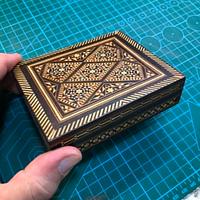
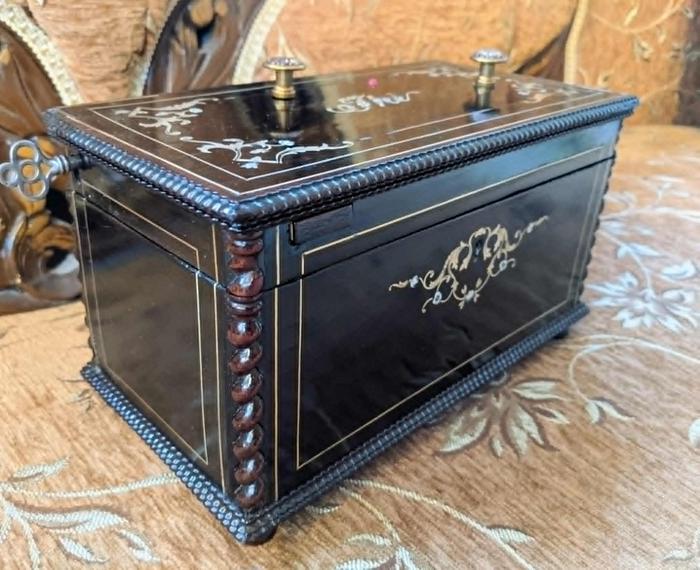
I have had this 19th Century Napoleon III ebonized Tea Caddy for a very long time, most likely finding it in an antique store way back when I started making puzzle boxes.
Some projects seem to carry more honour and respect for the process than just a build. A note came with this box saying it was found in at an estate auction held at Chartwell, the known home of Sir Winston Churchill back in 1979.
You know a wood article is old when you see that the craftsmen in their time used a 'scratch-stock' method for shaping/profiling these edges. Yowsa!
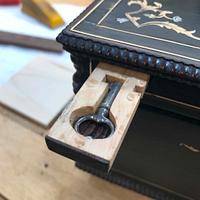
It was incredibly lucky that the little skeleton key came with it. I knew one thing for sure, ...that I wanted to make the key holder pop out when it was released after a bit of sequential discovery and few steps explored.
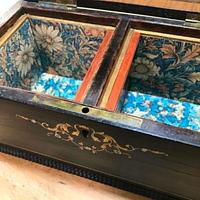
The first thing I needed to do was prep the box by adding a new inner lining, and since it wasn't being used for tea anymore I decided it would need the lining to be foil like it once was. Instead I found a William Morris book that had some fun scrapbook designs. Of anything I had on hand, this option seemed to flow best with the fine brass inlay.
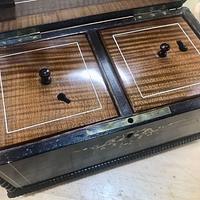
All of the surfaces needed to be sanded down below the vintage finish. The bone inlay in the canister lids had not shrunk with the wood for the last 100+ years it has existed.
A few of the brass inlay strips were out of their slots and all curled up. I was grateful that it was soft and easy to reconfigure.
One the box was repaired I was ready to begin. The first step was to make a rectangular hole in the front to carry the Pop-Out Key Holder. That was a bit nerve-wracking, as if there was going to be a nail, I would surely find it, and I did, lol. I knew there was a reason I have a dremel, lol
Between magnets and springs, it was important to make this mechanism self-lock as you pushed the Key Tray back in.
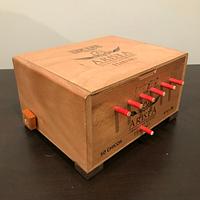
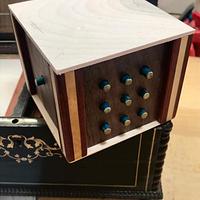
The first puzzle box I made is the last one to be solved, and this one is super difficult to solve. There are three different clues (all mathematical formulas to be solved) that reveal how many of the 18 push-buttons need to be pressed at the same time in order to unlock the drawer.
The blue-stained push-buttons matched with the colour of the inner lining of the tea caddy spaces.
If there is no clue given as to how many buttons to push, there is over 260,000 possible combinations. Hence the clues, the last clue tells them in plain English which buttons unlock.
In case this wasn't challenging enough to solve, the drawer know is too tiny to grasp, so that must be solved for too in order to have it long enough to grasp onto.
oh, we still have more to go? Damn, ...the push buttons are in a way that it will take two hands pushing in the buttons, leaving no hands left to open the drawer, ..and it is magnetically held in so it can't just fall out. So finding the right configuration with your available fingers is also part of the puzzle.
This was a very challenging mechanism to build and to get working with so many layers needing perfect alignment.
Inside this drawer will be the note that came with the box.
The other puzzle box has a simpler combination lock where you just have to enter the year of his passing, 1965.
Once inside, there is another door to pass through.
Here we meet another challenge as this cool dragon claw holding a Buga Sphere (or fill in your imagination), it spins and feels to have no effect. Once solved, you can remove the door and get the key for the next puzzle box.
oooo, ahhh, the next key!
This key is what releases the 2nd puzzle box.
Where is the key that releases the first box?
You may notice a key sticking out of the end of the lid, this is part of the solution to have the lid key popping out, but then removeable and to be used on releasing the first box.
I know right, ...and people like this, ...for fun, lol
I will have added much more to the underside of the lid then this pic was taken, but its enough to see the basic mechanics at play.
The hexagon knob you see to the right has a few functions. First, if rotated counter-clockwise it will lift the horizontal bar. But if rotated clockwise, then the pin in the hexagon knob can engage the horizontal bar and pull it to the right, effectively pulling the release for the pop-out key. No, none of this can happen until the brass pin is removed from the horizontal bar seen attached to the other hexagon knob on the left.
Some of the challenge here was creating the pop-out mechanics and NOT getting in the way of the lid knobs that poke up into the same headroom space.
The gracious 1" headroom in the lid allowed for all of this fun play!
Oh, the name of the box..... Sir Winston Churchill wasn't noted for drinking tea, he much preferred his scotch. This box was likely either a gift to him or a something that he might have gave to the staff as a gift. Either way, while building this I pictured him trying to sole this. And after a bundle of patient time, I saw him push back his chair and declare, ...F the T... Where's the Scotch!
You are a madman Kel! Incredible amount of work the owner has to put forth to get from the outside in. Incredible amount of work the builder has to put forth to make it all function and fit!
Waiting for the "Kel Kookie Jar" to frustrate the kiddies!
Complex cool, both for entrants, and builders. I personally don't have the patience to build something with as many twists and turns just to get to the tea, booze whatever is hidden inside. So can't build it, but would be fun to play with it, just as long as I really didn't need a drink.
Awesome work Kel, beginning to think you have a masochistic streak in you though.
Love how your mind works Kel, but I wouldn't mind betting that Churchill would just have got the guys and gals at Bletchley Park to solve the puzzles. That's where I imagine you would have worked had you been alive at the time.
For those that don't know, Bletchley is world-famous as the top-secret home of World War II codebreaking. At Bletchley Park, brilliant minds like Alan Turing cracked the seemingly unbreakable German Enigma and Lorenz codes. Their historic work shortened the war, saved millions of lives, and helped give birth to modern computing.
Andy -- Old Chinese proverb say: If you think something can't be done, don't interrupt man who is doing it.




.jpg)