Lots of chatter lately in the 3D printing forum about table saw blade inserts.
I have a late 90's Unisaw and the factory insert is pathetic, made for every blade width excluding a full dado stack. Maks crappy cuts with splintery plywood edges and any strip cut off thinner that 1/8" gets wedged in the opening forcing the blade over.
I've tried various shop made inserts, Oak, Melamine, and Baltic Birch plywood, all 1/2" thick.
Made with a template on the router table I can get a "perfect" fit to the table saw hole, no movement side to side or forward/rear. Cut a shallow relief in the bottom with an 8" blade to allow the insert to fully seat before raising the blade, then install a 10" blade and make the through cut. The oak and BB plywood work well and are quite flat and stable. They do have some drag when making a cut if they are not kept waxed. The melamine inserts are slick as snot on a doorknob and perfectly flat, but tend to get worn out around the blade kerf in short order.
I have hopes someday of using 1/4" or 1/2" aluminum plate to make future inserts, but bigblockyeti mentioned phenolic as something I had not seriously thought about.
Not one to avoid experiments, I hopped onto Amazon to check prices.
Searching for "1/2 Phenolic" yielded a few hits and a bunch of HDPE (too soft for my tastes).
OK, modify the search term with "-HDPE" to eliminate that chatter, but nooooo! Even more HDPE shows up. Anyhoo, finally found something to try.
I can live with the cost for my tests and I can get two made from the sheet plus some leftover for other uses.
Not exactly "perfect" flat, more like what I get with BB ply, very slight bow. Expecting better with a fine company like "Joyfolk", but I have ways to perfect it later. Quite "weighty" and very stiff!
I used a previously fitted BB plywood insert for the template and marked its outline onto the phenolic. To the bandsaw! Described as easy to machine, it cut easily. Smell immediately reminded me of all the bakelite I destroyed as a kid. Respirator mandatory!
Double sided tape used to attach my BB template and a bearing guided bit in the router:
Also smooth, no drama, and no worries about bit damage. Edge looks great off the table
I also used a 7/8" Forstner bit for a finger hole.
I lightly sanded the edge smooth and shoved it into the table saw, high point scuff marks showed where I could east the fit a bit. Those sanded away and the fit was nice and snug. Next up was to drill/tap holes for leveling set screws. Had some #10-32 x 1/2" handy so I used those.
I also applied blue Locktite to the set screw threads. Even with Locktite on the set screws used with the BB and oak inserts, the screws would loosen and cause issues. The most annoying is the insert dipping down below the saws table a few thousandths. The problem is with sawing narrow strips where the fence is over the right side of the insert. Inevitably the strip end gets hung up on the lip in the curve and gets pushed sideways.
Back to the phenolic, Final profiling with a round over bit on the router to ease the finger hole and bottom only of the insert. Top perimeter stays sharp for a no-gap fit and nothing for wood to catch on when I level it.
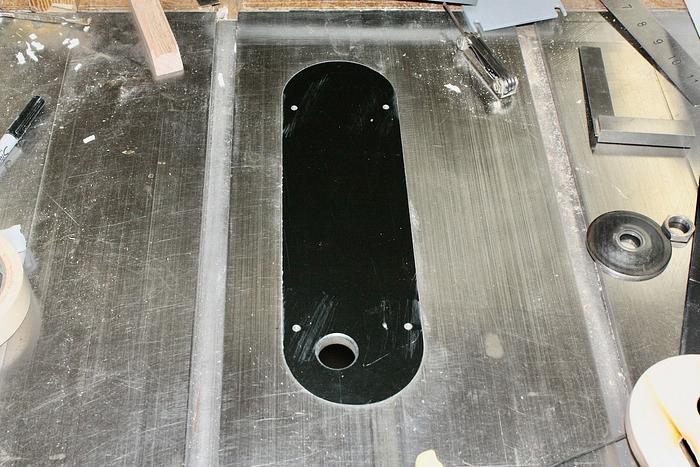
Screw installed in the rear so the insert doesn't get flung out from the blade.
Installed and leveled flush at the rounded ends.
The slight bow makes the center of the insert about 0.006" high where it meets the saw table, some sanding or scraping will bring that flat easily since this stuff is easy to work with.
That's it for now, I'll figure out what blade this is for later.
Overall impressions is this stuff is ideal for inserts. My future try with aluminum will still happen since that should be perfectly flat and last a long time. I may make the second phenolic insert with a replaceable strip around the blade kerf so I can use it for multiple blade types.
EDIT:
Went ahead and used a scraper, super easy and now is flush throughout. Killed the shine with a flat block and some 320.
Fortunately I have the luxury of being able to laser cut 6mm MDF which is flat and stiff enough for my hacking. The "lip" is just a hair short of 6mm and if I measure the thickness of the MDF stock (which varies between 5.8mm-6.2mm, due to cheape calipers used by Chinese MDF manufacturers) and dress it down to the right thickness on my drum sander before hitting the laser beam.
If your first cut is too short... Take the second cut from the longer end... LBD
Nice work Splint. Getting anything that’s truly flat is a real challenge. I wouldn’t worry about a .006” raise though unless your fence won’t clear it. Be sure to update in a few months and let us know how it holds up!
Thanks all! Kenny, my beef with the rise is when I need a square cur or specific angle. The "bump" means the part tilts as it passes by the blade. Besides, I'm a bit OCD!
That's my target Petey. An insert strip, though I'm thinking just a slot (no DT) and screws to secure. Easier to make replacements. One insert "base" with a collection of inserts for dado blades and one for standard blades and inserts for various angles and kerfs.
SplinterGroup commented about 7 hours ago new That's my target Petey. An insert strip, though I'm thinking just a slot (no DT) and screws to secure. Easier to make replacements.
Hey Splint... doesn't help people with engraver lasers and taking noting from 3D printing (even the inserts_, I believe your laser cuts 3mm.... consider...
If your first cut is too short... Take the second cut from the longer end... LBD
I wanted the phenolic since everything I have tried is just too flexy, even worse if I add a replaceable insert for the kerf.
The way you made yours is excellent and easily doable, but nothing I can cut with the laser would be stiff enough. My plate is 13mm thick and I have maybe another 3mm I could stack on top and still have it flush.
If/when I notch my new one, intent is to route out a recess about 4mm deep so I can use a variety of materials. I think I could actually DT the recess with a DT bit, but then the inserts would need to be worked the same versus just a bunch of ripped blanks.
3mm laminated will give you a stiffy, and you don't need to be mesmerised by MDF (the god's gift to woodworkers). A few bracers like this hint will provide stiffies.. 1 (or 2) lamination of 3mm MDF (underneath) will put salt in the mustard (FIIK, what that means). Laminates underneath may not look pretty, (especially from top down... doh), but where there is room underneath will only cost some extra glue.... and maybe dowel reinforcement if you are a pussie scardy cat.
If your first cut is too short... Take the second cut from the longer end... LBD
Great that you discovered this. I use it regularly (HPL Trespa panels) as a replacement for iron/aluminum. Iron and, to a lesser extent, aluminum are difficult for me to work with, but phenolic panels are easy to saw, mill, drill, and sand with woodworking tools.
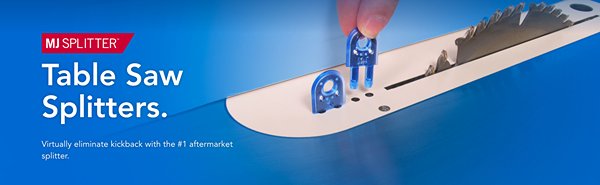
I like everything about the stuff except for the aroma while cutting. LBD is correct about a stiffener underneath, if I cut away at the top for a replaceable insert I'd probably add one below. I have a lot of 3mm aluminum strips from VME chassis face plates. When I had a ZCI made from 1/2" MDF, it was stiff, but the area around the kerf blew out quickly, Aluminum would take the beating much better. Duck also reminded me with his ZCI link that I have an MJ Splitter bought many years ago that I've never installed.
I also have some left over HPL flooring which is about 5mm.




.jpeg)