I have several 100 bf. of red oak that has been in the racks for several decades. I really have a love/hate (mostly hate) relation with this stuff as it is a bland wood and has that pronounced grain. Also likes to be splintery (which I reserve for my personality, not my materials!) 🤠
Anyhoo, wanted to put it to some use, so shelves were at the top of my list.
Browsing various images, I always liked the lines of this style Needed some more details so I wanted to place something into the vertical space on the sides.
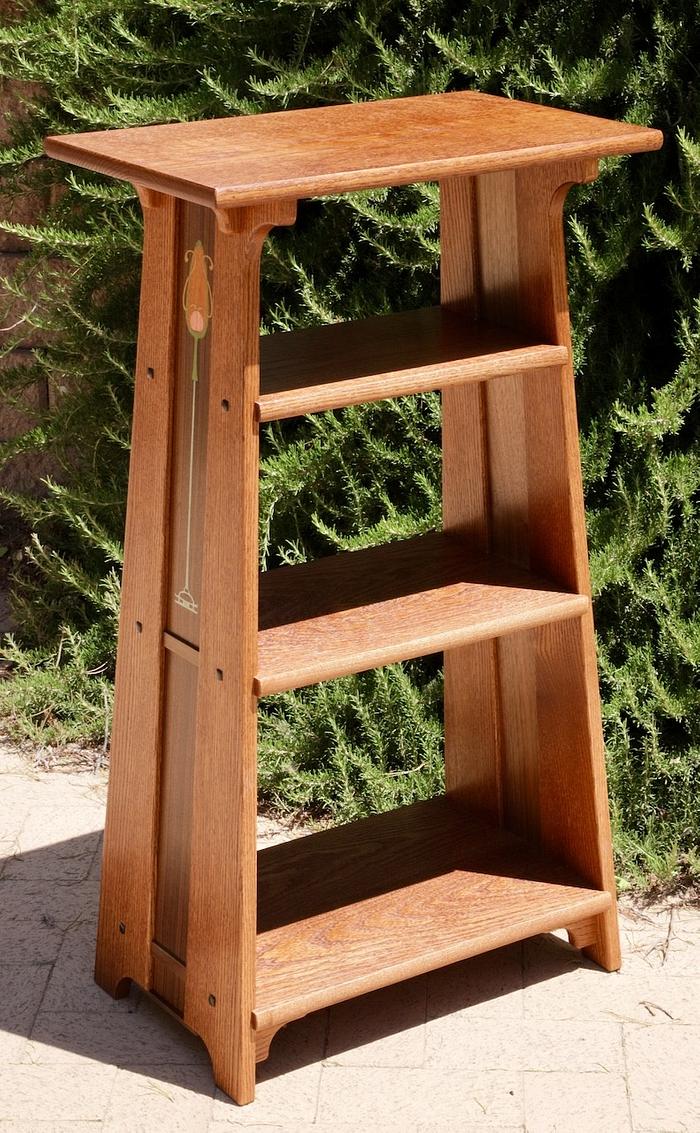
Came up with this: Same basic style. Deets: Red oak, 36" tall, top is 12"x20". Finish is a mix of TransTint dyes with Arm-R-Seal topcoat.
The basic slope of the sides is 4 degrees (leg splay and top/bottom taper)
Begins with the sides. The top and bottom cutouts plus the taper meant I wanted templates. The laser provided them for the ends and all the straight sections could be done with just some straight scraps. Layout on one side of a wide blank:
Before cutting to shape, I cut the shelf dados with the dado stack at 4 degrees off of 90. I also cut a slot 1/2" deep for the inlay panel between the legs.
Since the panel will sit mid way between the inside and outside of the legs, I wanted to fill the gap where the shelf goes past the panel on the interior. Also, due to the length of the sides, prepping the veneer for laser cutting for the pattern meant I would be working with a long strip of veneer in the laser. I wanted the design to run top to bottom but that means two sessions under the laser to cut the full length and it can get difficult to keep aligned. With a shorter section a lot easier so two birds, one stone. Divide the side panel into sections joined with "I beam" style couplers.
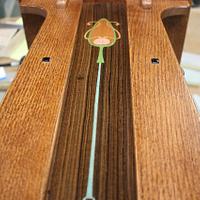
This is the coupler at the bottom (walnut). Biggest concern for this unit was expansion. The legs will be single point attached to the shelf sides with a single screw (under the ebony plug) and a few inches of glue. The panel will get tacked to the center of the shelf sides and slip fit into the legs. This means the legs can move side to side with the shelf expansion and the panel will remain centered. The notch visible in the picture showing the panel slot is for these couplers to also slide in/out.
Slot is 1/2" deep and panel will have 1/4" space when installed. Edge view:
The gap between the shelf and panel is small (1/16"), but doing it this way eliminated that gap. I'll have to rethink this next time as the extra work was a bit involved making the couplers and fitting.
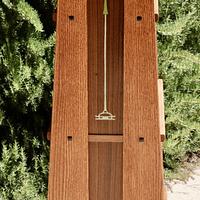
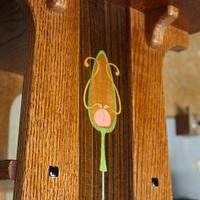
The panel is 1/8" BB plywood, walnut veneer on the inside and Lauro Preto rift veneer on the outside. This wood is cool looking! Inlay is a Harvey Ellis style which is perfect for tall/narrow areas. Laser cut patterns from some dyed and other natural veneer. Corbels are glued to the surfaces where the joint is long grain and 3/8" dowels for the cross grain. I moved the uppers from the inside on the original to the outside. Using tape to catch the mark, a pair of dowel centers worked perfectly to get all eight for the top aligned. Drilling was a challenge in the places where the 4 degree parts met the top, but worked out ok using an old computer disc drive platter to align the drill.
Corbels were shaped with a laser cut template in pairs, then spilt.
I didn't want the oak grain to get super dark as would have happened with any stain, so a mix, 3:1, of Dark Mission Brown and Reddish Brown TransTint in alcohol was used. Red oak has those freaking pores that are near impossible to get dye into and those that do fill will blow dye back out as it dries leaving dark "eyes". The alcohol has a lower surface tension vs. water so that helped with the penetration. I sprayed the dye on heavy then quickly scrubbed it with a rag to force it around. An after wipe 'n' scrub with alcohol on a rag helped even it all out. Not perfect, but got it where it was acceptable. Red oak sucks! Seal with 1 lb cut shellac then Arm-R-Seal top coat went well. I like the Arm-R, just takes a long time to dry between coats and flipping the parts to get the other sides.
Fun construction, easy design, just some noodling mid process to get the details to work.
Steven, That is a Harvey Ellis design (architect from early 1900's). He designed a lot of the inlay designs for Stickley. I believe they are flowers, mainly tulips.
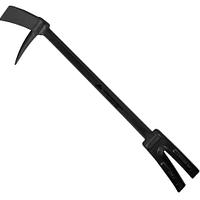
I don't collect knick-knacks to store on the shelves and not being an avid reader, I could always use something like that as a ladder if it wasn't such a show piece.
Drilling was a challenge in the places where the 4 degree parts met the top, but worked out ok using an old computer disc drive platter to align the drill.
Obviously you aren't a one eyed hand-held toolman as you are leading to computerisation (potential CNC). ..... Talking about CNC...
The top and bottom cutouts plus the taper meant I wanted templates. The laser provided them for the ends.....
If you bought yourself a Shaper Origin, think of the fortune you'd save in shekels by not having to make templates out of MDF/ply!
If your first cut is too short... Take the second cut from the longer end... LBD
You are making that red oak proud, nice job Bruce. I love the inlay and the A&C details, the form seems to lend itself that direction. You capitalized on the oak, using the rift for the legs where the dreaded cathedrals would kinda suc, and I see a glimpse of them on the shelves, where they aren't as in your face. You really got the most out of it. Nice job.
I really like the specimen that was your inspiration too. Not sure if it's Cherry finished up, Mahog, or another of the reddish South American woods, but the lines are great, and being a Shaker lover, it really bags simplicity, while having time tested beauty.
Nice build. I think others may follow your path here. Makes for a very nice table. If you are selling that, it will go fast.
George: I'm not a big fan of the cathedral grain, especially on oak where any stain will highlight it 10X. Much prefer the rift! Not sure of the wood in the reference photo, fine grain and obviously stained. Also did not like the exposed screw holes where I opted for hidden dowels.
LBD, yep! any form of CNC for those corbels would be great, especially since even paired, using the router table to shape was not much fun.
Even though this is not for personal use, I do think about what someone else might want to do with it. Had the idea to make the lower section tall enough for LP albums (vinyl records, analog, for you under 50 crowd!)
Really nice, Splint! Nice improvements over the original design. Like everyone else is saying, that inlay really makes the piece. And I’ve never seen red oak look so nice.
My Wife makes baskets, and currently she has a number of pyramid shaped metal things she puts them on. Something made of wood would really class up her display units. The shape of this is perfect for larger baskets to sit on the shelves.