Flutina Carry Case So another old project. I love wondering around antique shops and those of you that follow my work will have seen the two old French clock movements I discovered, restored and made a cases for. You can see them here, A grandfather clock and a Wall clock
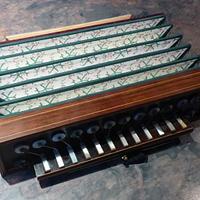
This project started when I found an old Flutina in the same antique shop in Boyanup, Western Australia, where I found the clock movements. It was in a sorry state - Its bellows were full of holes, the wooden frame had splits in it, several of its reeds, keys, and stops were missing, and most of its internal leather air valves were worn. It was a fun project to restore it. I made a completely new bellows. Cardboard and leather for the hinges plus some decorative paper I found on an American website that matched the original paper. I also made a couple of new reeds, and keys, and replaced all the leather lining the reed chambers.
Any how the restoration was fun, as was the research into its history. Alas I never got round to learning how to play it With the Flutina restored I decided to make a traditional carry case for it.
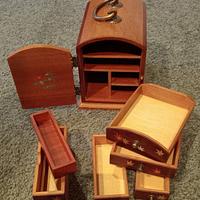
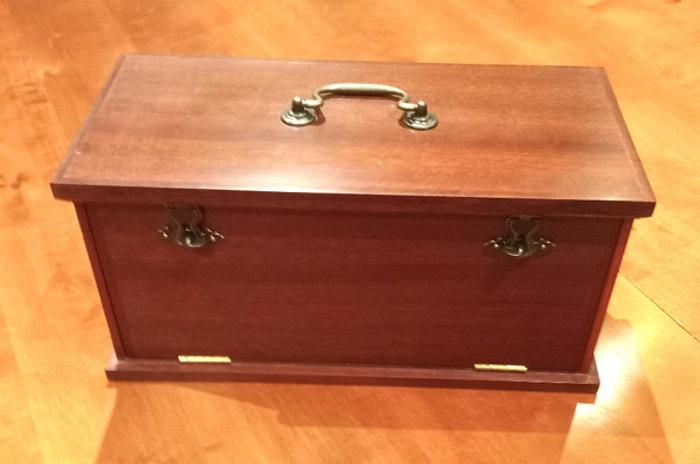
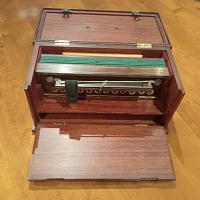
This is made from Jarrah and veneered plywood with period fittings, the originals would have been made from mahogany.
The case has a compartment in the base which holds the original bellows removed during restoration.
As always, thanks for looking.
Now if you are still interested then here's the results of my research into Flutinas.
Flutina – French Accordion
The accordion was invented by Cyrill Demian 1772-1847, of Vienna and patented by him on 6th May 1829. His original patent was for a 5 key accordion, but notes that the design is expandable, in respect of the number of buttons and tones. By July 1829 Demian was making models with 5, 6, 7, 8, 9 or 10 keys. These were diatonic and bi-sonoric. and tend to be called Viennese accordions.
Early Demian – Viennese Accordion
By the early 1830's a number of Parisian makers began building copies of Demian's single note accordions, with the press/draw system of notes. The earliest version was known as the Clavier Melodique - melodious keyboard, circa 1831. These were made by Pichenot Jeune , and were probably one of the first accordions capable of playing a melody. The first recorded factory was that of Napoleon Fourneaux in Paris.
The term Flutina is a specific English name of what the French called the Accordeon Melodies, Accordeon Diatonique, and Accordeon Romantique. They became known as the French Accordion. It is now classed as a ‘Free Reed Aerophone’ with a bisonoric action - it produces two different notes from the same key, one for each direction of the bellows.
8 key Flutina
10 key Flutina
This is my 12 key Flutina is from 1835 and probably made by Demian.
Later ones with more decoration were made by the prolific French maker Constant Busson. Mine has a single row of 12 treble keys, while the earlier Demian’s had from 5 to 10 keys. Each key is attached to a mother of pearl pallet covered with a leather pad that seals or opens a tone hole allowing air to rush through the two reeds underneath. One reed sounds as the bellows are opened, the other as the bellows are closed, so this one has 24 notes. It also has a rocker switch on top of the keyboard called the ‘bascule d'harmonie’. This switch, activated with the thumb, opens-up the pallets at each end of the soundboard, allowing a simple tonic/dominant effect of accompaniment - tonic while drawing and dominant while closing.
This Flutina has a Rosewood veneered body, and a typical 4-fold leather and cardboard bellows. The scale of this instrument starts on key 2 and plays Draw/Press - suck/blow sequence along the fingerboard. On the base is a brass spoon shaped ‘wind key’, or air valve, enclosed within a protective moulding. When operated by its lever, it allows the air to escape from the bellows, so silencing the reeds except for the ’rush’ of escaping air
As the bellows have only four folds, it makes the throw very short and so the duration of the note played is also very short, and the volume of the note is comparatively soft. This contrasts with the later accordions with their multi-fold bellows.
Flutina’s were often imported to the United States. Some were used by photographers, with subjects appearing to be playing the instrument, or just resting on their subjects knee as a prop. It gave the photographs a touch of culture, as women were pictured sitting with their hands folded over a Flutina, while they would probably never have played one. Many of these picture’s date from the 1850's, and on through the America Civil War period 1861-1865.
How to hold – a later Flutina with two rows of keys, the additional row gives bass notes
From : Cruickshank's Accordion and Flutina Teacher published 1852
There are pictures a some Flutina’s with a thumb loop attached to the brass bar at the back of the keyboard. This would help to control and hold the sound board while the fingers play the keys.
My Flutina is tuned to the A Major scale with the keys producing the following notes: Actual Keys/Notes, which closely match Jewett, Howes and Winners and Cruiskshank’s tutorial books. | 1 | 2 | 3 | 4 | 5 | 6 | 7 | 8 | 9 | 10 | 11 | 12 Draw | E | A | C# | E | A | C# | E | A | C# | E | A | C# Press | G# | B | D | F# | G# | B | D | F# | B | D | F# | G#
Don't take this the wrong way, but it is quite beautiful in it's simplicity. Much like Shaker, just plain gets it done. So much of your work is so detailed, and adorned with veneers, and all manner of dress up, this is a simpler looking chest. Now the work on the restoration sounds like a major work of art.
Thanks George. I like complicated projects hence the 'all manner of dress up'. Its what rocks my boat. The carry case was easy peasy, but the restoration was the complex part!! Thanks for the music link sounds quite good for such a small instrument!
Very nice storage for such a beautiful instrument. You have a very great talent to be able to restore the old instruments and give them a new life!!!!!!!!!!!!!!
Cheers, Jim ........................ Variety is the spice of life...............Learn something new every day
Great write up, and thanks for the info on what a Flutina is…I had no idea, but it does strike me as looking very classically French…all it needs is a powdered wig and some wine and it’ll be right at home!
Ryan/// ~sigh~ I blew up another bowl. Moke told me "I made the inside bigger than the outside".
Just having the fortitude to attempt dealing with all the bits of the bellows and air flow devices is amazing. Of course the box looks precision made as with all your works.
Awesome! Also interesting info on the device, like many here I had never imagined such an item existed.
another amzing build. as most said, never heard of this instrument before. i cant even imagine how to go about restoring something like this. well done.
working with my hands is a joy,it gives me a sense of fulfillment,somthing so many seek and so few find.-SAM MALOOF.