
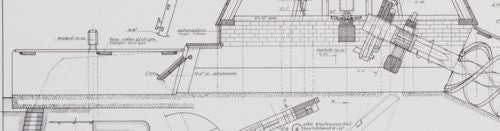
Fundering
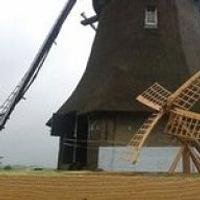
This mill has a concrete base and brick stone walls. According to annotations on the drawing the mill wasn't built like this. It had a stone foundation and the screw housing was made of wood. I will be making my model like this. star

This mill has a concrete base and brick stone walls. According to annotations on the drawing the mill wasn't built like this. It had a stone foundation and the screw housing was made of wood. I will be making my model like this. star
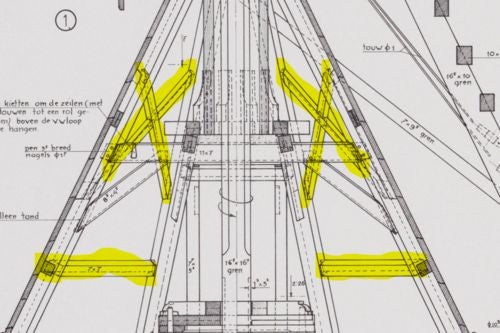
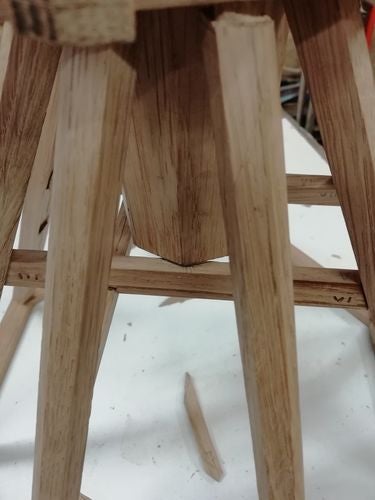
To add more stiffness to the construction of the housing of the windmill there is additional bracing. These crosses are not in the fields where the doors are so I need to make six of them. Starting off with very small lumber
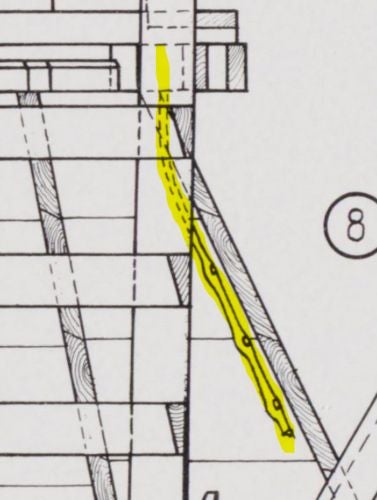
The "boventafelment" is also anchored on the beams with 4 metal anchors. On the drawing these are placed on the outside. But I want to be able to take the cladding off to show the inside. So I will change the layout and put the anchors on the inside
After finishing the kokerbalken en korbelen the tube can be fitted Measuring the placement of the tube Cutting the recess Fitting the tube It all fits together
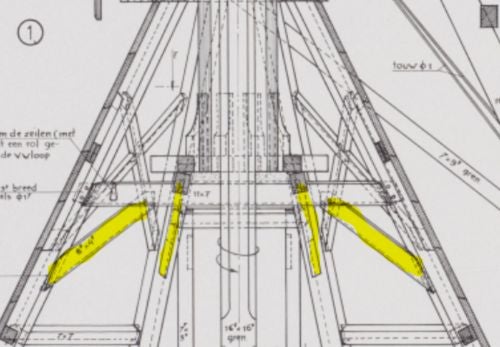
With the posts and the girders made, its time to make the "korbelen". These knee braces help strengthen the construction of the lower part of the windmill and prevent it from skewing. Cutting the angles on the knee braces Ma

To support the tube (koker) and to give strength to the lower part of the windmill there are "kokerbalken" (girders?). They form a bent together with 2 posts and 2 knee braces. Taking measurements Making the mortises

Just some pictures of putting all the parts together Lower end of the post fitting the "onder tafelment" Top end of the post and the "boven tafelment" Numbering the pieces Finished so far.

At the top of the lower house of this windmill there is a round flat part where the top of the windmill rests on and that makes it able to smoothly turn the upper part of the windmill into the wind. The part is called "de pannenkoek", the pancake. The

Having finished the "onder tafelment" and the "boven tafelment", now I will make the posts, and because the shape of the underside of this windmill is octagonal (in most cases it is a square ) these part are called octagon posts (achtkant stijlen)

This part of the mill is called "koker" and can be translated as tube. It is part of the bottom part of the windmill and allows the main drive shaft to go from the upper part to the lower part. It also allows the top of the windmill to be turned to fa

In the previous blog a made the "onder tafelment", now I am going to make the "boven tafelment" (onder is under and boven is upper). It is located at the top of the underpart of the windmill. It is made up of 4 pieces and has lap joints. There are als

Boys and Girls, In the previous video, I got lost in how to cut on my MFT layout on a short board. It was and embarrassing long delay, portraying me confused and speechless, trying to silently run multiple, futile scenarios through my brain