
The short answer: hard maple, walnut, cherry and beech. They're hard enough to stand up to knives without dulling them, close-grained enough to resist soaking up liquid, and safe for food. That's why most of the cutting boards Craftisian members share are some mix of those woods.
The longer answer depends on how the board will be used, whether you're building edge grain or end grain, and which finish you'll put on it. Here's what to look for, which woods to avoid, and how members have put it into practice.
What makes a good cutting board wood
- Hardness in the right range. Too soft and the surface scars quickly. Too hard and it dulls your knives and is a chore to flatten. Janka hardness of roughly 900 to 1,500 lbf is the sweet spot.
- Closed, tight grain. Woods with small pores absorb less moisture and food residue. Open-pored woods can wick liquid deep into the board, especially on end grain.
- Food safety. Use common, well-known domestic hardwoods. Some exotic species are strong skin and respiratory sensitizers, and anything with an unknown history (reclaimed boards, pallets) may carry finishes or chemicals you can't see.
- Stability. A board gets wet and dries again for years. Stable, straight-grained stock with no checks or knots will stay flat.
The best woods, compared
| Wood | Janka hardness (lbf) | Grain | Notes |
|---|---|---|---|
| Hard maple | 1,450 | Closed, fine | The benchmark: durable, knife-friendly, light colour shows stains |
| American beech | 1,300 | Closed, fine | Traditional for butcher blocks. Moves more with humidity, so keep it oiled |
| Yellow birch | 1,260 | Closed, fine | Similar to maple and often cheaper |
| Black walnut | 1,010 | Medium pores | Gentle on knives, hides stains, a favourite for contrast strips |
| Black cherry | 950 | Closed, fine | Darkens beautifully with age. Slightly softer, so it shows knife marks sooner |
| White oak | 1,360 | Pores plugged by tyloses | Acceptable. Its pores are sealed, which is why it's used for barrels |
The figures are average side hardness. Individual boards vary, but the ranking holds. For more on these species, see the most common types of wood used in woodworking and woodworking with walnut.
Woods to avoid, or use with care
- Red oak. Its pores are open along the length of the board, so end-grain red oak wicks liquid like a bundle of straws. It's fine for a bread or cheese board that's oiled often. Keep it away from raw meat.
- Softwoods such as pine and fir. Too soft, and resinous. A season of chopping leaves them deeply scarred.
- Very hard or abrasive woods. Hickory (around 1,820 lbf) is tough on knives. Teak is beautiful and water-resistant, but its high silica content dulls edges quickly.
- Exotics known as sensitizers. Cocobolo is the best-known example. If you use colourful exotics such as purpleheart or padauk, keep them as thin accent strips and wear a dust mask when cutting them.
- Spalted, punky or reclaimed wood. Spalting is fungal decay. It looks great on a wall, but it's soft and porous. Reclaimed boards may have old finishes or treatments in them. Never use pressure-treated lumber.
- Plywood and MDF. The glue layers and the core aren't meant for food contact or knife cuts.
End grain, edge grain or face grain?
The same wood behaves very differently depending on which surface faces up.
| Construction | Kind to knives | Durability | Difficulty | Best for |
|---|---|---|---|---|
| End grain | Best. The knife slips between fibres | Excellent, cuts close up | Hardest: two glue-ups and flattening a big end-grain surface | Heavy daily chopping, butcher blocks |
| Edge grain | Good | Very good, stays flat | Moderate: one glue-up | Everyday boards, your first build |
| Face grain | Fair | Shows cuts, more prone to cupping | Easiest | Serving and charcuterie boards that show off figure |
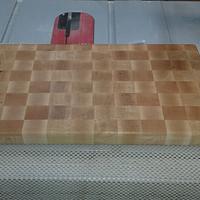
End grain has one practical catch that members mention again and again: flattening. Dark_Lightning made a 10" × 20" hard maple end-grain board for his wife and ended up building a router sled, then finishing with a belt sander, because maple end grain is too hard to level reliably by hand. If you plan to make several, a drum sander or a router flattening sled is worth it.

Glue: use a water-resistant PVA
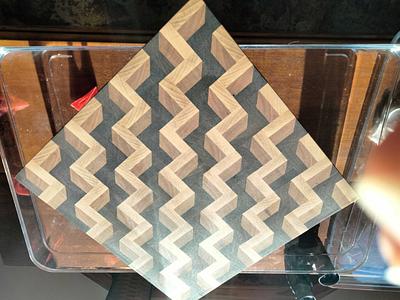
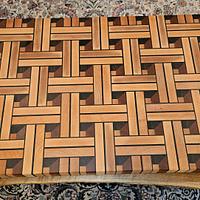
A cutting board gets washed hundreds of times, so use a water-resistant wood glue. Titebond III meets the ANSI Type I water-resistance standard and is approved for indirect food contact. Its longer open time also helps on complicated glue-ups. Petey recommends exactly that for his 3D woven end-grain board in cherry, walnut and maple, where dozens of pieces have to be aligned before the glue grabs.
Finishing: food-safe and easy to renew
A board that sees knives needs a finish that soaks in and can be renewed at home. Film finishes chip and peel under a blade.
- Food-grade mineral oil. The standard. It never cures, so you'll re-apply it, but it's cheap, safe and won't go rancid.
- Board butter. Mineral oil melted with beeswax, about four parts oil to one part wax. The wax adds some water resistance and a soft sheen. Mark Michaels finished his framed red oak end-grain board with this mix.
- Curing oils. Pure tung oil and raw linseed oil cure to a harder, food-safe finish but take days to weeks to cure fully. Check the label: many products sold as "tung oil finish" are thinned varnish blends.
- Avoid cooking oils such as olive or vegetable oil. They can turn rancid in the wood.
Serving-only boards are different. For a charcuterie board that will never be cut on, a wipe-on poly or other film finish is fine, as long as it's fully cured before food touches it.
Tip Oil a new board generously: flood it, let it soak in for a few hours, wipe off the excess, and repeat until the wood stops absorbing. End grain drinks much more than edge grain.
Caring for a wooden cutting board
- Wash by hand with warm, soapy water and dry it standing on edge. Never put it in the dishwasher or leave it soaking.
- Re-oil whenever the surface looks pale or dry. That's monthly for a board in daily use.
- Lift stains and odours with coarse salt and half a lemon, then rinse and dry.
- If the surface gets badly scored, sand it back and re-oil it. A solid wood board can be refreshed for decades.
Cutting boards from the community
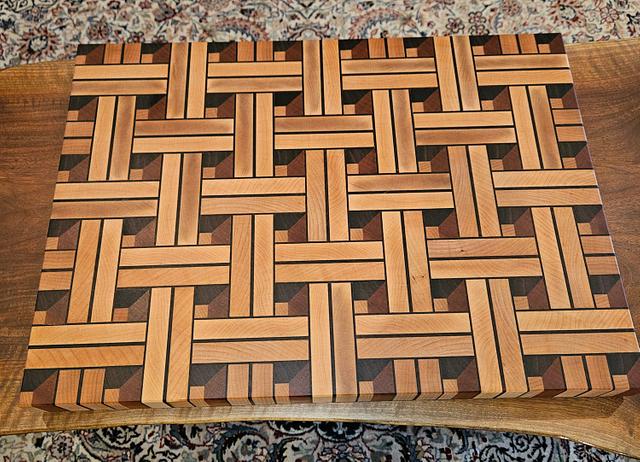
If you want to see the range of what's possible, start with Lightweightladylefty's first end-grain board, a wedding gift with 570 pieces in six species. Then look at Peter Jones's scaffold-pattern boards in walnut, maple and cherry, and his chain mail end-grain board.



Browse more end-grain projects and cutting boards, and if you're building one as a gift this year, see our Community Showcase for more gift ideas from members.
FAQ
Is walnut safe for cutting boards?
Yes. Black walnut is one of the most popular cutting board woods. It's a little softer than maple, so it's gentle on knives, and its dark colour hides stains.
Can I use oak for a cutting board?
White oak is acceptable because its pores are sealed. Red oak is best avoided for boards used with raw meat, because its open pores soak up liquid.
What is the best finish for a cutting board?
Food-grade mineral oil, or a mix of mineral oil and beeswax. Both are food-safe and easy to renew. Save film finishes like polyurethane for serving boards.
Is end grain better than edge grain?
End grain is kinder to knives and hides cut marks better, but it takes far more work to build and needs more oil. Edge grain is durable, easier to make and the better choice for a first board.
Are bamboo cutting boards good?
Bamboo is a grass, and bamboo boards are thin strips laminated with a lot of adhesive. They're hard-wearing but noticeably harder on knife edges than maple or walnut.