

Every piece of wood has three kinds of surface, and most of what happens in a woodshop depends on which one you're looking at. How well a joint holds, how a finish takes, how much a tabletop moves, and why an end-grain cutting board costs more than an edge-grain one all come down to grain orientation.
The easiest way to picture it is a bundle of drinking straws. The straws are the wood fibers, running the length of the tree. Look at the bundle from the end and you see the openings: that's end grain. Look at the side and you see the length of the straws: that's long grain, which comes in two versions, face grain and edge grain, depending on which side of the board you're looking at.
| Face grain | Edge grain | End grain | |
|---|---|---|---|
| Where it is | The wide faces of a board | The narrow edges of a board | The cut ends of a board |
| What you see | Arches or wide figure | Tight, straight lines | Growth rings and pores |
| Glue strength | Strong (long grain) | Strong (long grain) | Weak on its own |
| Takes finish | Evenly | Evenly | Soaks it up, turns darker |
| Seasonal movement | Most, across the width | Less | Almost none along the length |
Face grain
Face grain is the wide surface of a board as it comes off the sawmill. On ordinary flatsawn lumber it shows the familiar arches, sometimes called cathedrals, where the saw cut across the growth rings at a shallow angle. It's the surface you see on most tabletops, panels and slab furniture, because it shows the most figure and gives you the widest pieces.
A good example is jbschutz's walnut. He was given a log about 42" long and 12" across, had it sawn into 1" boards, and air-dried them stacked on stickers in his garage rafters for two years. Those boards became a set of live-edge cutting and serving boards, each one a single piece of face grain.


Face grain is also where wood movement shows up. Wood swells and shrinks with humidity across its width, not along its length, so a wide face-grain board is the part of a project most likely to cup, crack or change size between summer and winter. That's why you'll often see bow ties in slab work. GoodmanDesigns put a padauk bow tie into a 24" × 9" walnut serving board, and BerchtoldDesignBuild used inlaid ash "stitches" across an open crack in a walnut slab desk. The inlays look decorative, but their job is to keep the crack from getting longer.
A face-grain cutting board, like Paul's quick walnut board with a freehand juice groove, is the simplest to make: one board, cut to shape, sanded and oiled. The trade-off is that a single wide board is more likely to warp, and knife marks show more than on the other two types.
Edge grain
Edge grain is the narrow side of a board. On its own it's just the edge, but when you rip a board into strips, turn each strip 90° and glue them back together, the edges become the working surface. That's how most striped cutting boards, butcher-block countertops and workbench tops are made.
Edge-grain glue-ups are popular because they're stable. Narrow strips with the growth rings running more or less vertically move less across their width than one wide flatsawn board, and the many glue lines resist cupping. They're also hard-wearing and show tight, straight lines that make the stripes look crisp. gdaveg's boards are a good example, with purpleheart, maple and padauk in alternating strips:



If you want to build one, our weekend edge-grain cutting board guide walks through the whole process, from choosing strips to the final oil.
End grain
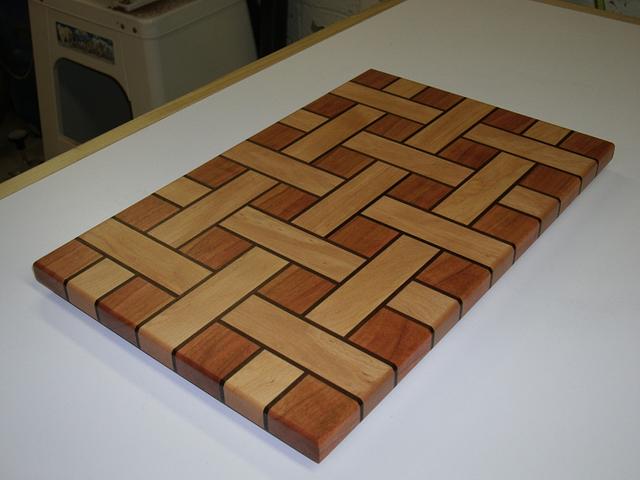
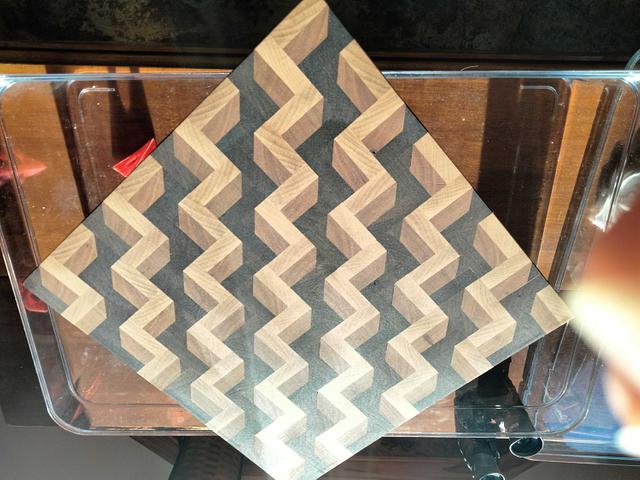
End grain is the cross-section of the tree: the cut end of a board, where the fibers are cut across and you can see the growth rings. On its own, a board only has two small patches of it. End-grain cutting boards and butcher blocks are built by gluing up an edge-grain panel, crosscutting it into strips, turning each strip on its side and gluing again, so the whole surface is made up of fiber ends.
That's why end grain is so kind to knives. The blade slips between the fibers instead of cutting across them, and the fibers close up again, so the surface hides cuts and keeps an edge sharper for longer. The same open structure has downsides: end grain soaks up water and finish like a sponge, and it's more prone to cracking if it dries out. End-grain boards need regular oiling for that reason.
Hilltop woodworking's coasters show end grain about as clearly as it gets. They're slices of a 4×4, charred with a propane torch in the shou sugi ban style and finished with cutting board oil. The torch burns the softer earlywood faster, so every growth ring stands out.


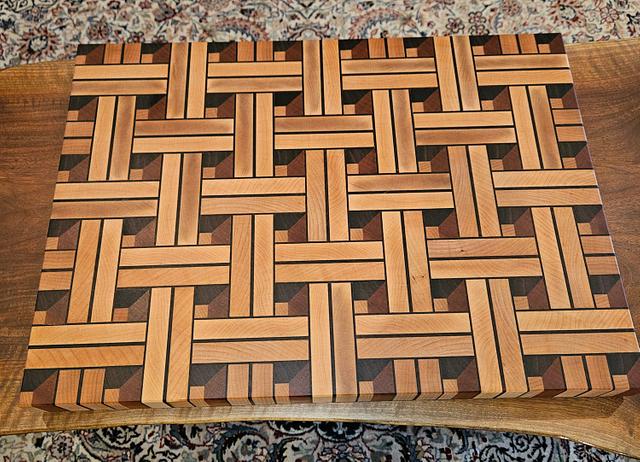
End grain is also where the most elaborate boards come from. The cover of this article is Lightweightladylefty's first end-grain board, made as a wedding gift: about 13" × 18½" × 1¼", built from 570 pieces of cherry, walnut, oak, birch, maple and ash, glued with Titebond III and finished with mineral oil. For a simpler start, look at Brian's maple and mahogany boards or Wes Louwagie's 2" thick silver maple board with walnut accents.
How grain direction changes your work
Gluing
Long grain glued to long grain (face to face, edge to edge, or face to edge) makes a joint that's usually stronger than the wood around it. End grain glued to anything is weak, because the open fibers soak up the glue and leave little on the surface. This is why joinery exists: dovetails, mortise and tenons, and box joints all turn an end-grain connection into long-grain glue surfaces. It's also why end-grain cutting boards hold together: every glue joint in them is actually between the long-grain sides of the pieces.
Wood movement
Along its length, wood barely moves at all with changes in humidity. Across its width it can move a lot, and more in the direction of the growth rings than across them. In practice:
- A wide face-grain top needs room to move. Fasten it with figure-8 fasteners, buttons or slotted holes, not rigid glue all around.
- Don't glue a long-grain piece across a wide panel along its full length. This is called a cross-grain joint, and it's how breadboard ends and battens end up cracking a top.
- Quartersawn and edge-grain stock moves less across its width than flatsawn face grain, which is one reason edge-grain counters and benches stay flat.
Finishing
Because end grain absorbs more, it comes out darker under stain or oil than the long grain next to it. To even things out, sand end grain to a finer grit than the faces, or seal it with a thin coat of finish or glue size before staining. On cutting boards you want the opposite: flood the end grain with oil until it stops soaking in.
Planing and tearout
Long grain has a direction. Look at the edge of a board and you'll see the fibers rising toward one end, a bit like the grain on a cat's fur. Plane or joint "downhill" with the fibers and you get a clean surface. Go against them and the blade lifts fibers and tears them out. End grain needs a very sharp blade and a low cutting angle, which is what block planes are made for.
Which grain is best for a cutting board?
| Face grain | Edge grain | End grain | |
|---|---|---|---|
| Build effort | Low: one board | Medium: one glue-up | High: two glue-ups |
| Kind to knives | Less | Less | Most |
| Shows knife marks | Yes | Yes | Hides them |
| Upkeep | Occasional oil | Occasional oil | Regular oil |
| Typical use | Serving, bread, light prep | Everyday cutting | Heavy chopping |
Whichever you choose, the wood matters as much as the grain. Our guide to the best wood for cutting boards covers which species to use and which to avoid.
Frequently asked questions
What is long grain?
Long grain is any surface where the fibers run along it rather than ending at it. Face grain and edge grain are both long grain; end grain is not.
Is end grain or edge grain better for a cutting board?
End grain is easier on knives and hides cut marks, but it takes longer to build, costs more in material and needs more regular oiling. Edge grain is quicker to make, very durable, and good enough for most home kitchens.
Can you glue end grain?
You can, but the joint is weak on its own because the fibers wick the glue away. Where end grain meets another piece, woodworkers use joinery like dovetails or mortise and tenons, or reinforce the joint with dowels or splines, so the glue holds long-grain surfaces.
Why does end grain turn dark when I stain it?
End grain is made of open fiber ends that absorb far more stain than long grain. Sanding the end grain to a finer grit, or pre-sealing it with a washcoat, keeps it closer in color to the rest of the piece.
Is face grain the same as flatsawn?
Not quite. Face grain just means the wide side of a board. Flatsawn describes how the board was cut from the log, with the growth rings running roughly parallel to the face. A flatsawn board's face grain shows arches; a quartersawn board's face grain shows straight lines, because the rings meet the face at a steep angle.
Built something where grain direction made the difference? Post it as a project and tell us how you handled it.