I’m in no way experienced in the ways of the dark router,
however, I can say with some confidence I might know a tad more than somewhat that doesn’t, or hasn’t even heard of or seen it.
If you’ve read the threads regarding the WorkStation (WS) you may have appreciated that I wasn’t the greatest fan of the original MDF shelf top that came in at a whopping pissant dimensions of 298.5mm x 115mm, only to be falsely humiliated by a bigger pissant top of 410mm × 280 mm in the upgrade kit., 340% bigger,
but in my humble opinion, still not big enough.
Furthermore, I was exacerbated by the thought that after a few through cuts the shelf would be marred and need to be replaced and because of the mounting holes’ profiles the shelf wasn’t easily “flippable”, to use the reverse side.
Instead of the 18mm single layer MDF shelf, I considered a 12mm MDF static base with an interchangeable 6mm MDF skin (and maybe even a 3mm one). This would reduce the replacement expense by around 2/3. But the conundrum was how to attach it without interference of the Origin movement and accidentally ruining the router bit.
Naturally the anchor point for the skin would need to be outside the Origin travel and its profile must not impede matching surfaces to permit double sided taping of workpiece to the skin.
Hit SketchUp and after replicating the shelf support and stand’s anchor bolt positioning,
Initially chose to use my TSO Loc-Dogs to anchor the skin to the base,
however, by the time I got to export the design to create SVGs, I also considered using 6mm rubber riv-Nuts,
as anchor points and for alternative SVGs,
The skins I could cut on my laser, however, for the base, I imported the SVG into Shaper Studio
imported it into Origin,
and used the Origin to cut it,
Once the base was cut, it was time to attach the shelf support and support stands using the 6mm bolts
as once the skin is on top
it will prevent access.
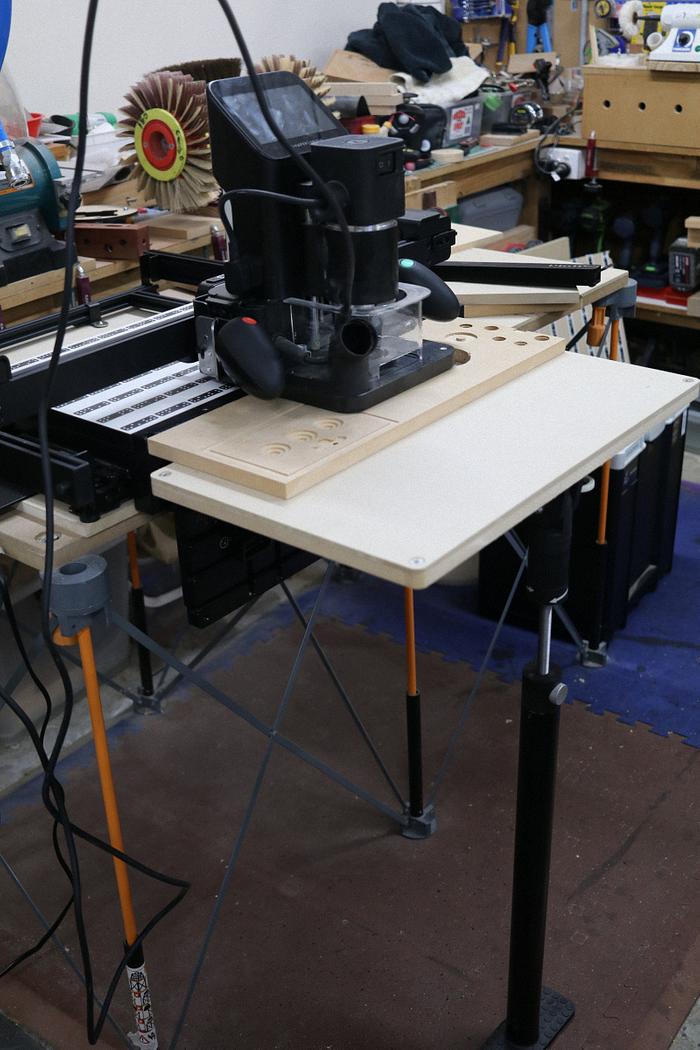
The skin is secured to the base using these rubber riv-nuts and a 6mm threaded countersunk bolt,
Providing an obstruction free MDF shelf/spoilboard,
(picture also shows using the support bar to level out the shelf with a support stand underneath).
The new tabletop,
was deliberately sized so that the BenchPilots limiting router travel, stops short of the riv-nut/bolt hardware,
extreme bottom-left travel.
Now I was also stuck with the new resized upgrade shelf support and MDF shelf without the anchor for the support stand as that was transferred to my shelf upgrade.
A set of callipers for measurement and Sketchup to the rescue,
backed up by my Speedy 100 laser,
FYI, once one delves into beefier shelves, and load it up with workpiece(s), they become heavy and may will require support. I have suggested a form of support anchor if you have a Shaper support stand or one can be fabricated with a suggestion of using a button nut,
that will provide both quick height and subsequent micro adjustment to level out the shelf with the WS using the support bar,
I have confined the size of my shelf to the travel of the BenchPilot, however, there is no reason why it can’t be extended to support/manouver large workpieces.
Thanks for watching.
Don’t be crafty Craftisians,... SHARE your craft!
If your first cut is too short... Take the second cut from the longer end... LBD
So are you going to go the big Boy shelf? And in doing so I assume its back to manual control of the Shaper Lets see a full frontal of the Shaper stand, the brief upskirt looks to me to be something like linear motors may be able to level for you, and complimented with some bullseye levels installed lust below the surface obviously That should have you cooking with gas!
That is an enormous amount of work before you can even begin. Although I haven't read the entire series, it is clear to me that you have created a clear instruction set for many. Personally, I think I will keep sanding a lot.
Dutchy, this is far from what most people want, however, the scope of the Origin has me dreaming... you with your imagination/inventiveness would revolutionise the use.
It reminds me of my thoughts about a 3D printer at a Woodworking Show that piqued my interest 13 years ago... while it's still a not "must go to", it is being more and more embraced. A CNC is in that same non-sinking boat... however, the Origin takes it a step further with it's versatility... which depends on the user and not the naysayers.... horse to water... don't blame me if he/she prefers Scotch.
If your first cut is too short... Take the second cut from the longer end... LBD
Hi Alex, sorry I have been missing in action lately, I became a full time carer for my wife a couple of years ago, however things are on the improve for her so hopefully I can get back to reading more of you reviews again. Obviously this Origin machine piqued my interest but I don't think it will do what I want and for the price I couldn't justify it. I had never heard of the Origin before reading your review, thanks for sharing.
Nice write up Duck. I have looked at the Origin a few times, and it gives me the "Domino fever" much worse than the Domino ever did, and Lord knows the fever lasted a long time before I finally broke down, and ponied up the price. Of course having a Domino to use whenever I liked has been an amazing thing, and I kick myself for ever hesitating.
I'm pretty much in the same place about an Origin, only XXXXXX many $$$$$$$$$ signs.
I did notice this Summer they have a sale of sorts, but still not doing enough woodworking to make a plunge that deep, maybe if my recovery continues as I hope it could be at a later time. It is a rather big bite in my azz that when I started musing I could have bought the damn thing for pennies vs the current pricing.
Thanks GW... Price forgiving, it would get a decent deposit by selling your Domino it could replace... Like CNC, laser, 3D printing, there is a learning curve that many may not evaluate... however, if one has the diversity and imagination, I have been gobsmacked at what it can/will do with the right mental background/approach. Being on the back end of recovery, I "also" lack inspiration for diversified projects that would be eaten up with the Origin.
It's just a shame that other users with much more experience and nous than I, have not heralded it's potential. It's a bucketload of shekels up front, but when some debate the pros and cons (-$$$) of a Domino (or the lesser Kreg), it's gonna be cheaper today than tomorrow... I look at my oft promoted TSO loc dogs that now retail for $39.95(USD) that I bought just a few years ago for a tad under $30.00(USD)... damn, I thought it was a big tad cheaper... but 33% is still a decent rise.
If your first cut is too short... Take the second cut from the longer end... LBD
Can't really fault the people making these tools, if they are selling what they make, raise the price, if they keep selling, raise it again. Not sure about worldwide, but it is certainly the American way to success and riches. I mean who goes into business to be a nice guy? At least the only peeps who think they should be "nice guys" are those who already think everything they want should be free. No not you, just free for Meeeeeeee. Not a realistic lot are they? :-)
I have no issues with people entering a market to make money.... why else would you... I do have objection to people that then abuse (subtle difference to blame) them for price increases... it should be expected My attitude is that when I see something and like it, buy it now as it'll cost a shitload more tomorrow.
If your first cut is too short... Take the second cut from the longer end... LBD
Fine lines between when a product is introduced, goes through the price changes to find the supply/demand point, then faces the cheaper knockoffs and a new S/D point needs to be reached.
I always figure the price will go down in the future, but the product wouldn’t be mine to use until I buy it…so I either get increased value by spending more now and having the product to use, or I save money (possibly) in the future, but don’t have the product to use until that point. It’s the difference between cost and value. Sometimes one wins, sometimes the other…and sometimes I get it all wrong too!
Ryan/// ~sigh~ I blew up another bowl. Moke told me "I made the inside bigger than the outside".
Nice to have one of those machines. I bought a vertical mill for metal working and use it all the time for woodworking. It is the HNC ( Human Numerical Control) type- I turn the handles! I have made big stand for it and lots of jigs and clamps to hold the work in all kinds of orientations!
Cheers, Jim ........................ Variety is the spice of life...............Learn something new every day



.png)

%20%E2%80%94%20Mozilla%20Firefox-011246.png)
%20%E2%80%94%20Mozilla%20Firefox-011247.png)