
Learning the basics of metalworking is essential for anyone who wants to work with this versatile material. It can seem daunting at first, but with a little practice, you'll be able to create beautiful and functional metalwork pieces. In this blog post, we'll outline some of the most essential techniques every metalworker should master. Keep reading to learn more!
Metalworking involves the use of various tools to cut, shape, and join metals together.
The most essential tools for metalworking are those used to cut and shape the metal. A safe and effective means of cutting a piece of sheet metal is with a shear, which typically operates with a foot pedal or push button. It slices through metal like a pair of scissors cutting paper – only much faster – allowing you to make multiple cuts in one pass. When cutting metal, always wear safety glasses to protect your eyes from flying debris.
To shape sheet metals, you can use a punch press with steel dies for raised lettering or with round tooling to stamp out numerous shapes in different sizes. You can also use an English Wheel to form metal over a curved surface. After compressing the metal between the anvil and the wheel, use a chasing hammer to create indentations along the edge for decoration.
The most common types of metalworking are welding, riveting, and soldering.
Welding is a process of joining two pieces of metal by heating them to the point where they melt and then fusing them together. This can be done using an oxy-acetylene torch, a MIG welder, or a TIG welder.
Riveting is the process of joining two pieces of metal by driving a rivet through them. The rivet is a short piece of metal with a head on one end and a tail on the other. The tail is inserted into a hole in one of the pieces of metal, and the head is then pounded down so that it expands and holds the two pieces together.
Soldering is the process of joining two pieces of metal by melting a small amount of solder between them. Solder comes in a variety of alloys including tin-lead, silver, and copper.
There are a host of other metalworking techniques used to produce different results. For example, flanging is a technique that uses a flanging tool with male and female dies to expand the edge of sheet metal for use as an enclosure or housing.
Welding is the process of joining two pieces of metal together by melting them together with a welding torch.
There are different types of welding, but they all consist of heating the metals to a molten state so that they fuse together.
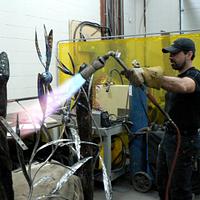
The most common type of welding is done with an oxy-acetylene torch in which oxygen and acetylene gases are mixed together in a torch to create a very hot flame that bums at about 6,000°F. The pieces of metal to be joined are melted and joined by applying the flame directly to them with a welding shield protecting the surrounding area from the heat and high intensity light emitted by the burning gases.
A less common method is shielded metal arc welding (SMAW), which is done by placing a consumable electrode between two pieces of metal and passing an electrical current through the electrode to create a welding arc. This produces molten metal that is used as filler and fuses with both pieces of metal.
Gas tungsten arc welding (GTAW), referred to as TIG welding, bums a non-consumable tungsten electrode and uses a shielding gas (typically argon) to protect the weld area from oxygen and other contaminants. The molten metal is drawn from a separate piece of filler rod rather than being produced by the electrode as it is in SMAW.
GTAW typically produces less heat distortion around the weld area because it operates at lower temperatures, which makes it ideal for metals that are heat sensitive. It also requires more skill to master than SMAW, so it is typically done by someone who has had formal training on how to use the machine and the filler rod.
Another welding technique, called plasma arc welding (PAW), uses an oxy-acetylene flame for buming like SMAW does, but instead of arcing the current to the metal, it uses an electrode which produces a plasma jet.
Riveting is the process of joining two pieces of metal together by driving a rivet through them.
A rivet is a metal rod with a head on one end and a tail on the other. The tail is inserted into a hole in one of the pieces of metal, and then the head is pounded down until it expands and holds the two pieces together.
The most common type of riveting uses either an air hammer or hydraulic press that applies significant force to the rivet head.
There are also other types of riveting tools including a pneumatic riveter, a riveting hammer, and a drill-powered rivet buster.
Rivets can be soft or cold headed, which means they have been heated only enough to soften the metal so that it is easily pounded; or they can be hard headed, which means they have been heated to make them stronger.
Soldering is the process of joining two pieces of metal together by heating them until the solder melts and bonds them together.
Solder is a metal alloy that melts at temperatures much lower than the metals it joins. It also has a much lower melting point than the metals used in brazing and welding, which makes it an ideal material to use for joining different types of metals because it doesn't cause as much damage to their surfaces or heat distortion.
There are two common types of solder used for joining metal including eutectic and hard.
Eutectic solder is the most common type of solder because its melting point is very close to the melting point of the metals it joins, which makes it ideal for soldering metals that are similar in their melting points. The only difference between eutectic solder and the metals it joins is that its melting point is lower.
Hard solder is typically used for joining dissimilar types of metal together, such as copper to steel or brass. Unlike eutectic solder, hard solder has a higher melting temperature than the metals being joined together, so more heat must be applied to it to melt it.
Both types of solder are available as wire-like strands, sheets, beads, or other shapes meant to be used for joining metals together.
What tools do you need to start with metalworking?
There are a few basic hand tools that you need to start with in order to get started with metalworking.
These include hammers, pliers, files, screwdrivers, scrapers, cutters, wire brush wheels and brushes, vise-grips clamps pads for protecting your hands while using the tools etc.
If you’re planning to try welding, you also need a welding helmet and fire proof clothing.
Once you get good at welding, you might want to invest in more advanced tools such as TIG or MIG welders, or even a small cutting torch for getting into tight areas.
What are the most important safety precautions?
You should always wear protective gear while working with metal, especially when you are welding or grinding.
This includes an apron to protect your upper body from hot sparks and molten metal, safety glasses to protect your eyes from the bright light of welding, gloves for protecting your hands from burns, steel-toe boots to protect your feet in case something heavy falls on them and a welding helmet that protects your face and eyes from the brightness of the sparks.
You should also always have a fire extinguisher close by in case something catches on fire, and you should learn how to use it just in case it’s needed.
Conclusion
If you are looking to invest in a new hobby or want to start your own business, metalworking is an incredibly rewarding and fulfilling path. It’s also one of the most accessible forms of art because all you need is some basic hand tools like hammers, pliers, files, screwdrivers, scrapers and cutters. You can work wherever there’s enough space available too so long as it isn’t near anything that might catch on fire! If this sounds fun but intimidating at first glance just remember that with practice comes mastery—and who doesn't love being able to say they're a master?